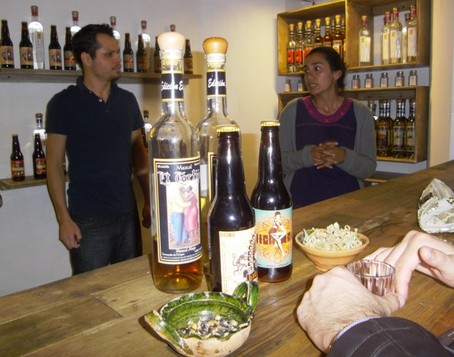
The southern Mexico state of Oaxaca has long been known as the nation’s capital of mezcal, the agave-based alcoholic beverage. In 2011, it took a giant leap forward in another direction with the opening of its first nano-brewery, Teufel. Oaxaca was actually slow off its marks; decades earlier micro-breweries in the Western World had begun making small-batch craft beer, thus refining the collective palate of brew aficionados in Canada, the US, Europe, and further abroad. Then in early 2013, Teufel began experimenting with pairing a selection of its craft beers, some with uniquely Oaxacan ingredients, with different mezcales.
Background to Pairing Beer & Mezcal in Oaxaca
Drinking mezcal and cerveza together is nothing new. For decades, if not centuries, Oaxacans of all walks of life have been imbibing the two at a single sitting, be it in downtown restaurants, at intimate social gatherings, or at any one of a myriad of rites of passage festivities held at anywhere from rural homesteads to upscale event halls. In fact European style beer brewed with barley, and the distillation of baked, fermented agave, were both introduced into Mexico in the 16th century.[1]
Simply combining beer with mezcal is not pairing. Until recently the tradition has been to select a particular mezcal, of course assuming that a choice is available, and similarly a beer. The latter has generally been a brew produced by one of Mexico’s two main breweries. Giving thought to what kind of beer goes better or best with what mezcal, rarely, if ever, crossed the minds of Oaxacans, regardless if native or foreign born. But that has begun to change. It was no coincidence that about the same time that Teufel began production, the first retail outlet opened selling exclusively craft beers from around the globe.
Pairing Teufel Craft Beer with Mezcal El Cortijo
It began as an experiment, that is, gauging the receptiveness of Oaxacans to the concept of pairing beer with mezcal. The project developed during the course of discussions in late 2012 between Teufel partners Fernanda Sueldo and Fernando Bolaños, and their friends, brothers Juan Carlos and Raúl Méndez Zamora, fifth generation producers under the label Mezcal El Cortijo. El Cortijo has actually been distilling mezcal in Santiago Matatlán, about an hour’s drive outside of Oaxaca, since 1951.[2]
It is not suggested that readers run out and buy bottles of Mezcal El Cortijo to match the pairings indicated. While the spirit is agreeable enough, there are literally hundreds of other brands which produce quality mezcal using espadín; blanco, reposado, añejo and gusano, and mezcales made with other types of agave, pechuga, etc. In fact, as noted, at least with the beers which were paired, mezcal made with the more unusual varieties of agave are perhaps imbibed solo, while the more pedestrian mezcales seem to be enhaced with Teufel, and vice versa.
A special edition mezcal with a serious gusano flavor was paired with Teufel 77, named in honor of the punk movement which began in that year. The beer is 99% malt and 1% miel de agave, an India Pale Ale in the English tradition with a touch of bitter at the finish. The medium body brew excellently tempered the mezcal’s flavor which I found a little too strong for my palate. There was no clash, the beer holding its own alongside an otherwise overpowering gusano.
Next, a three year añejo aged in American white oak barrels was paired with an Irish style red made with another local ingredient, rosita de cacao (flower of the cacao), an ingredient traditionally used to make the pre-Hispanic non-alcoholic beverage known as tejate. The special ingredient is actually the aromatic flower of a bush, the Quararibea funebris often referred to the funeral tree flower. The vanilla, green coffee and cinnamon tones of the añejo were excellently paired with the beer which maintains just a hint of maple, imparted by the rosita.
Our third offering was a 44% espadín blanco with green apple undertones selected to compliment one of Teufel’s benchmark brews, its Babalao. The beer is made with local blue corn, thus imparting a dark brew appearance, yet it has a light body. The colors contrasted yet the drinks were well paired, with the beer allowing the mezcal’s character to predominate. Babalao is one of Teufel’s most important products because with the use of corn as an ingredient it pays homage to Oaxaca as arguably the first region in the world where corn was cultivated, its primitive precursor, known as teosinte, dating to 7,000 years ago if not earlier.
Our final offering was a 46% cuixe with herbal and butter tones paired with Teufel’s 77. Once again I enjoyed the brew: However, I did not find that it added anything to the mezcal, and in fact seemed to mask an otherwise excellent product. What I learned, at least on a provisional basis, is that mezcal which has a decent level of complexity, whether made with wild or cultivated “designer” agave, or with espadín which can be put into that special category, should perhaps be drunk alone – or dare I state imbibed with a commercial light beer, so as to not detract from the nuances imparted by the agave and / or production method.
The Future of Beer & Mezcal Pairings
The two evenings held at the downtown Oaxaca retail outlet of Mezcal El Cortijo were successful. The first was oversold, with patrons sitting both at and behind the bar, and standing. The second was full, though not to the same extent. The questions, the commentaries, and the overwhelming interest, all suggest that in Oaxaca, pairing mezcal, with at least craft beer, will grow. There will undoubtedly be further formal tastings. It is anticipated that eventually beer and mezcal aficionados will then quickly begin to scrutinize what they pair for themselves, and offer to their guests.
As mezcal’s star continues to rise in the larger centers in Mexico, and in the US, Canada and overseas, pairing with craft beer will likely become chic. Whether it will filter down to the more regular folk here in Oaxaca, is another question.
Alvin Starkman has been an aficionado of mezcal and pulque for over 20 years. He operates Casa Machaya Oaxaca Bed & Breakfast (http://www.casamachaya.com) with his wife Arlene, and Oaxaca Culinary Tours (http://www.oaxacaculinarytours.com) with Chef Pilar Cabrera Arroyo. Alvin organizes personalized small group mezcal and pulque tours, and arranges Oaxacan food and craft beer pairings at the Teufel cervezaria.
[1] Some archaeological investigation suggests that indigenous populations were distilling prior to the arrival of the Spanish, though more accepted version of the history of alcohol in Mexico indicates that mezcal was first produced in the country in or around 1578.
[2] The Méndez family began producing mezcal in Santiago Matatlán in 1795. At its peak this one town boasted 300 palenqueros.
 RSS Feed
