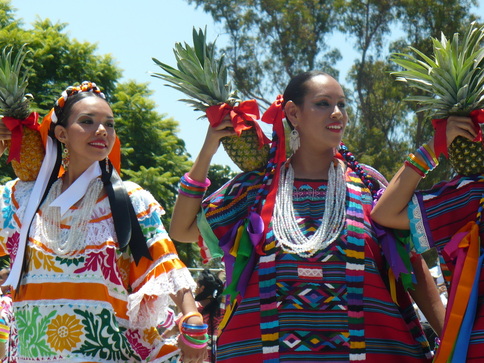
With pageantry unrivalled in all of Mexico, the Guelaguetza is the most colorful and exhilarating of the multitude of festivals in Oaxaca. And in a state with 16 different indigenous cultures, each with its own unique traditions including language, food, music, dress and dance, it should come as no surprise that the annual two-week July extravaganza draws both Mexican nationals and tourists from all corners of the globe.
The official Guelaguetza celebrations, commonly referred to as the Lunes del Cerro (Mondays on the Hill), take place in an open-air auditorium on a hill overlooking the city of Oaxaca, the state capital. The festivities occur the last two Mondays of July, except if the second last Monday of the month falls on July 18, the anniversary of the death of Benito Juárez, Mexico’s first indigenous president and Oaxaca’s native son. In this case the celebrations are enacted on the subsequent two Mondays.
Folkloric dance troupes come to Oaxaca, the UNESCO World Heritage Site, from the farthest reaches of the eight regions of the state to perform their distinctly unique dances to the tune of traditional native music. It’s all carried out live in the amphitheater. The performances (an estimated 16 delegations will perform at each Guelaguetza in 2012) are designed to convey the nature and richness of day-to-day life in the particular part of Oaxaca, ranging from representations of rites associated with marriage, to coastal net fishing. Some have a not-so-subtle but always humorous sexual subtext manifest in both dance and the recounting of local tales. Imagery and movement are sufficiently universal so as to ensure that knowledge of Spanish is not a pre-requisite for enjoying and becoming thoroughly enthralled in what is being expressed through dance, music, and at times light dialogue.
Guelaguetza has been translated from the Zapotec both as “offering” and the “reciprocal exchange of gifts or services.” The pre-Hispanic origins of the Guelaguetza assist in unraveling the relationship between its literal meaning and its current format, including why, where and when regional delegations descend upon Oaxaca to reenact indigenous rituals.
More than three thousand years ago the hunters and gatherers of the region began to develop a more sedentary lifestyle, in large part due to the cultivation of corn, then other foodstuffs such as tomatoes, squash, beans and chiles. Corn remained the key staple, and the rains which traditionally began during the summer months assured its growth and an abundant supply throughout the year. It thus became usual practice to pay tribute to the gods and goddesses responsible for bountiful yields during mid-summer to ensure that the rains continued and thus produced the healthiest of fall harvests. This manifested in the offering and trading of initially foodstuffs and then locally handcrafted products such as clay pots and other wares. The feast of Xilonen , goddess of young and tender corn, fell on what is in the Christian calendar July 16.
The Spanish, upon their arrival in Oaxaca in 1521, on the one hand attempted to impose their beliefs on the indigenous peoples through conversion to Catholicism, while on the other sought to maintain at least some relevance for tribe members, through reinterpreting their longstanding traditions. One way was to incorporate the Guelaguetza into the celebration of the July 16 feast of the Virgin of Carmen, beginning at the downtown Oaxaca church of Carmen Alto, once a Zapotec site.
Eventually the Guelaguetza began to focus on the two Mondays following July 16, and its location changed to the “Cerro del Fortín” which during the 15th century had been the location of Aztec garrisons. The ridge was, and thereafter remained, a place for gathering, and celebrating the Guelaguetza.
In 1932, as part of the city’s 400th anniversary festivities and its designation as a royal city by King Carlos V of Spain, the forerunner of the modern Guelaguetza was born, with representatives of ethnic groups from the different parts of the state invited to participate. Thus, 2012 takes on special significance, and has been designated by the state of Oaxaca as the festival’s 80th anniversary – “80 aniversario homenaje racial Guelaguetza (1932 – 2012).”
La Temporada de la Guelaguetza is a time for every Oaxacan to set aside political differences and concerns over inequalities and struggles, and pay tribute to the state’s multiplicity of rich cultural traditions. The festivities also serve as a reminder that both government and the people must, for generations to come, strive to preserve indigenous heritage through promoting the maintenance of each culture’s precious customs.
Just as Super Bowl Sunday in the US draws TV audiences unprecedented throughout the rest of the year, so too does Lunes del Cerro in Oaxaca. From morning until evening on those two Mondays, every year, television stations broadcast the Guelagueta. Nary a restaurant, hotel, craft store, jewelry shop, or even market stall can be found which is not tuned in to the live performances.
Watching the Guelaguetza at the Cerro del Fortín is awe inspiring. It adds to our respect for and greater appreciation of the different customs, mores and traditions which have endured for centuries, and in some cases millennia. It reminds us of the state’s rich array of rituals.
At the end of each troupe’s performance, members toss gifts (i.e. offerings) to those in the stands; products brought down from their particular sub-region, ranging from palm leaf hats, fans and mats, to coffee, fruits, vegetables and nuts, to souvenirs created specifically to distribute. One cannot help but leave the Guelaguetza exhausted from cultural overload, but with a special understanding of the magic of Oaxaca. For the vast majority of Oaxacans the Guelaguetza instills a renewed gratification for their native legacy.
This year, ancillary events include the downtown parade of delegates on the Saturdays, and Sunday evenings at 8:30 p.m. at the same auditorium the performance of the legend of Donají, the last Zapotec princess (at a cost of 100 pesos for seating in palcos [stands] A & B, upper seating free). Though still in its planning stages, on the Sunday evenings a performance entitled Las Tradiciones del Istmo is scheduled to take place at a much smaller open air venue downtown, La Plaza de la Danza. There is frequently a children’s Guelaguetza performed in the Alameda de León, adjoining the zócalo. Check for posters with details of events in the centro histórico upon your arrival in Oaxaca.
The 2012 Guelaguetzas take place on July 23 & 30, at 10 a.m. & 5 p.m. (free in the upper sections, but attend hours early to be assured seating; otherwise, tickets are 800 pesos for Palco A and 600 pesos for Palco B, available through tourism offices, Ticketmaster and select travel agencies; ticket prices are more if purchased through the latter two). Each event lasts about three hours.
Many towns and villages hold free Peoples’ Guelaguetzas during the two week period. Ask for dates, times and locations at your lodging. They too are very entertaining. But nothing compares to the state sponsored Guelaguetzas on the Cerro del Fortín; experiencing all the color and pageantry on a grandiose scale while sitting in the stands, the stage in front, the spectacular valley of Oaxaca and distant mountains as backdrop.
Alvin Starkman attended his first Guelaguetza in 1991. He is a paid contributing writer for Mexico Today, a program for Marca País – Imagen de México. Alvin and his wife Arlene operate Casa Machaya Oaxaca Bed & Breakfast (http://www.oaxacadream.com).
 RSS Feed
