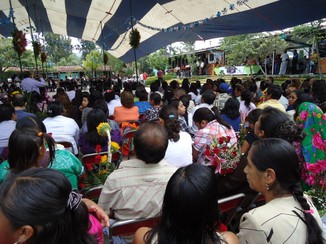
In 2011, a crowd approaching 2,000 proud parents, relatives and friends attended these junior high school graduation exercises in Tlacolula, about 45 minutes from Oaxaca. There were speeches, live music, presentation of graduation certificates, and prizes for academic excellence. Oaxacans do take education very seriously, but many need the assistance of others to ensure their children realize their potential.
For decades, both Americans and Canadians have been supporting efforts to provide young Oaxacans with improved education; donating not only their time and expertise, but also books and related educational resources, food and clothing to make attending school easier for children of families with very limited resources, and cash. But while US taxpayers have been able to deduct donations to certain registered Mexican charities from their income, Canadians have not. Finally change is in the wind, as a result of CANFRO, Canadian Friends of Oaxaca Inc.
CANFRO was incorporated as a non-profit organization pursuant to the laws of the Province of Ontario in January, 2012. It has applied for designation as a charitable organization pursuant to CRA (Canada Revenue Agency) regulations, and expects to receive approval by the end of the year. Once approved, it can issue tax-deductible receipts.
While on paper its objectives appear broad, such as supporting women, improving accessibility to healthcare for residents who survive only marginally, and more generally relieving poverty, each of CANFRO’s seven projects is directly related to improving educational opportunities for youthful Oaxacans.
Administrative Framework & Functioning of CANFRO
The Government of Canada does not allow Canadians to obtain tax relief for donations made directly to established Oaxacan non-profits, through CANFRO or otherwise. Rather, funds to support Oaxacans and / or pay for goods and services for their benefit, must be paid to the individual or a third party provider.
The implications of this are twofold. Firstly, administration costs are kept to a bare minimum, since by not donating through a Oaxacan charity no portion of the gift is used for the charity’s operating costs. Secondly, Canadians in Oaxaca, currently the CANFRO directors, must initially select worthy projects, and then devote their efforts to paying funds to the appropriate recipients, ensuring the money is spent as represented to the Canadian donors, and securing the necessary paperwork so that they obtain tax receipts from CANFRO as authorized by CRA.
However, Oaxacan charities do play an important role in the process. In most cases they are utilized in at least one of two respects: to identify the candidates and programs in need; and to act as a conduit or intermediary; CANFRO makes use of charity premises and established routines. An examination of its existing projects clarifies the scheme, while at the same time exemplifies precisely how Canadians can help educate Oaxacans.
Current CANFRO Projects
Some CANFRO projects overlap. However each has a distinctly unique mission, enabling Canadians to choose the form of aid which best suits their preferences, as well as their financial means. Donors who are familiar with an existing Oaxacan charitable organization, and are perhaps already contributing to it without getting tax relief, might gravitate towards it.
The Hearing Aid Project: If not detected early enough, hearing impairment results in lower educational achievement than would otherwise be attainable. CORAL (Oaxacan Center for the Rehabilitation of Hearing and Speech), is a non-profit organization consisting of an audiology clinic, hearing and speech therapy facility, early detection hearing loss program and a social work component which includes in-home training for parents in outlying communities. Hearing aid batteries often last as little as 10 days. On behalf of donors, CANFRO purchases solar powered hearing kits for children with hearing loss. CORAL selects appropriate recipients.
The Women’s Project: CANFRO donors can fully and directly support a bright young indigenous woman in her quest to obtain a high school education. Funds provided are used for meals, accommodations, transportation, educational costs, clothing and healthcare expenses. They also pay for costs related to attending monthly weekend workshops and extended summer sessions at Casa de la Mujer; for mentoring regarding sex, birth control, woman’s rights and self-esteem, as well as psychological and occupational counseling. Casa de la Mujer makes recommendations regarding worthy candidates.
The Advanced Education Project: This initiative is similar to The Women’s Project, but is for promising students of both sexes and not associated with any organization. It may include university education. It is more for donors wishing to decide upon their own recipients or rely on either another individual or one of the non-profits to assist in screening and selecting. The project does not include a workshop component.
The Tutor Project: University students from Oaxaca, as well as those from outlying areas who have migrated to the state capital for higher education, often do not have sufficient resources to complete their studies. CANFRO pays these young adults to tutor high school students in difficult subject areas, both individually and in groups. Thus, benefits accrue to tutors and their students alike. In addition, the tutors provide excellent role models for students of similar social class. Tutoring occurs at The Oaxaca Learning Center.
The Book Project: Reading is a major component of learning. Fifteen years ago a group of Oaxacan residents began a literacy program, Libros para Pueblos, opening children’s libraries in Oaxaca. It has annually expanded into the villages. Proof of its success is the fact that many books have become worn and even “lost.” CANFRO supplies replacement and new books for rural libraries.
The Food & School Sponsorship Projects: These two ventures involve participation of El Centro de Esperanza Infantil (The Center of Hope for Children). Years ago it was brought to the attention of The Center´s founders that many children were falling asleep in Oaxacan schools. As a result of a lack of parental resources students were not receiving the nutrition required to be physically ready to learn. CANFRO donors supply funds for daily hot meals served at The Center, giving youth the energy required to participate fully in their education. But the children require more. El Centro also assists in identifying students worthy of donor support in the form of resources to buy equipment, supplies, uniforms, shoes, books, school fees and medical services.
When to Begin Supporting the Education of Oaxacans?
There’s no need for Canadians to defer donating until tax deductibility is available, likely by December. Canadians have been helping to educate Oaxacans for years with after-tax earnings. Consider initially donating directly to a charity noted above, thereafter paying through CANFRO once CRA approval is confirmed.
Alvin Starkman is one of CANFRO’s directors. He and his wife Arlene operate Casa Machaya Oaxaca Bed & Breakfast (http://www.casamachaya.com). Alvin can be reached at [email protected] for updates regarding supporting Oaxacan education. Alvin assists tourists in planning their visits to the state capital and central valleys.

 RSS Feed
