Ninety-two year old Isaac Jiménez, a pioneer in the modern age of mezcal, gently rocks back and forth in his old wooden mesadora, a rocking chair, in his Matatlán homestead, struggling with his failing senses of sight and sound, memory still sharp. “When you ask me about the history of mezcal de pechuga, I’m sorry, but I can’t take you back any further than about 1930,” he apologizes, then continues, “when Ramón Sánchez arrived in Matatlán with his family.”
My mission to uncover the origins of mezcal de pechuga, and to a lesser extent catalogue variations in its formulations, lead me to Don Isaac, whose grandfather first arrived in the self-proclaimed world capital of mezcal, Santiago Matatlán, in 1870. Doubtless, there are several theories and legends, at least as many as exist regarding the first time a Oaxacan released a gusano into a glass of mezcal.
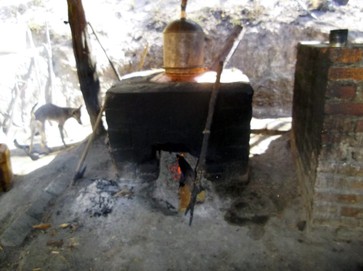
Those under the impression that mezcal de pechuga contains only the essence of chicken breast, which when raw had been suspended inside a still over which steam produced from fermented baked agave passed, are in for a lesson. Formulations, more in the nature of recipes, may call for wild turkey breast, rabbit leg, deer meat, or no protein at all, with fruit and / or herbs and spices, sometimes infused in prepared mezcal rather than being integrated into the distillation process.
Mezcal de Pechuga Arrives in Santiago Matatlán
“I was about 10 years old, so it must have been around 1930 when Ramón Sánchez put down roots in town, apparently coming from Río Seco, or at least that’s what he told everyone,” recalls Don Isaac. At that time Río Seco would have been days away from Matalán, whether by foot or beast of burden. It’s near the junction of the now districts of Tlacolula, Ejutla and Miahuatlán, agave growing country; so residents of Río Seco also made mezcal.
“Then in 1938, a fellow by the name of Chuy Razgado came to Matatlán,” Don Isaac continues. “One day he showed up at Hacienda Los Lope where I was playing with my band-mates.”
In Oaxaca, as in other parts of Mexico, there has been a longstanding tradition of playing band, woodwind and percussion instruments, proficiency beginning at a young age. The youthful Isaac learned to play alto saxophone, eventually becoming a member of a band. He and his fellow musicians occasionally played at Hacienda Los Lope which was owned by a family of Spanish aristocrats.
The day that Razgado attended at the Hacienda, he had no instrument in hand. But he asked if he could hang out with Isaac and his fellow musicians and somehow contribute. The band rejected the overture since at that time there was no indication as to how he could help. Eventually, after subsequent failed attempts to integrate into broader Matatlán, Razgado disappeared.
One day Isaac and his mother, Felipa Arrazola, travelled to Mitla to buy provisions, and they came across Razgado. Since Isaac had now become an accepted part of the region’s music scene, and the two had to stay in Mitla for at least an overnight because of the distance they had to travel to get there, it was easy for them to find lodging. But that first evening Isaac and his mother by chance encountered Razgado drinking in a cantina and playing music; but not just any music. He was playing bottles; glass bottles of different sizes, shapes and neck openings, thus yielding different sounds. He used both his breath and a makeshift drumstick to create different sounds. He was playing melodies reminiscent of the music of the Isthmus of Tehuantepec, near Oaxaca’s Pacific coast.
At the end of the set Isaac and his mother seized the opportunity to speak to Razgado, Isaac now clearly humbled by someone it had become clear to him was a true, multi-facet talent, whom he and the other band members had rejected weeks earlier. At the time Isaac was learning how to read music. In the course of discussion with Razgado he realized that he was in the company of a true maestro, a musician who played more than just bottles. Isaac recognized that an opportunity existed for him to further his own musical skills while at the same time have someone in town, Matatlán that is, who could tutor others. Razgado accepted the invitation to return to Matatlán, and there began to teach and to play, not only bottles, but also guitar, trumpet, sax and a couple of other traditional instruments.
Ramón Sánchez quickly learned about Chuy Razgado and the work he was doing within the Matatlán community of musicians. He decided to throw a special reception in his honor. During the festivities Sánchez presented Razgado with a large bottle of mezcal de pechuga. Others at the event also imbibed the pechuga, many for the first time. Prior to this occasion, while Sánchez had shared his pechuga with some, no one really took notice of the unique flavor nuance, and if they did they didn’t ask about it. The cat was out of the bag, and mezcal de pechuga was born, at least for broad public consumption. Perhaps more importantly, it had become elevated to the status of a spirit for special occasions.
No one knows for sure if villagers in Río Seco had been making mezcal de pechuga, if Sánchez was the only palenquero with such a recipe, or if it was first prepared by him in fact after his arrival in Matatlán. We do know two things: since the honor of receiving mezcal de pechuga was first bestowed upon Razgado, pechuga has been served in many Oaxacan towns and villages at special fiestas; and, there are several formulations of the spirit.
Epilogue to Chuy Razgado & Ramón Sanchez
In 1940 General Lázaro Cárdenas travelled to Mitla. While there were still no paved roads in or leading to the village, General Cárdenas nevertheless rode there, to inaugurate the arrival of electricity. It would take another 19 years for electric lines to get to Matatlán.
By then Razgado had become well-known and a highly respected musician in both Matatlán and Mitla. The mayor of Mitla invited him to play for General Cárdenas during one of the celebratory dinners. Razgado did not dress up to perform. He played a brief first set. No one applauded. For the second set he was part of a trio, and at its conclusion a bit of praise was bestowed upon the group. For the third and final set Razgado lead the local philharmonic orchestra in four songs, decked out in formalwear, a suit traditionally worn by band leaders. General Cárdenas called him to the box where he and the other dignitaries were seated, to congratulate him. Perhaps the clothes provided the inspiration for an exceptional concluding performance. Razgado was known to throw back a few, so perhaps by evening’s end mild inebriation had contributed to his excellence.
Three or four months later Chuy Razgado once again disappeared, this time never to return to the region. Word has it that he died in the Mixe district of Oaxaca.
Ramón Sánchez continued to make small batches of mezcal, including pechuga, for his own use and to provide to others who had become aficionados and / or wanted it for fiestas. None of his progeny became palenqueros. During that era there was a pervading perception that making mezcal was not a dignified trade, much the same as leading the life of a musician. In the case of Don Isaac, he paid little if any attention to public sentiment, and continued to excel at both vocations.
Mezcal de Pechuga in Mexico Today
According to Enrique Jiménez, son of Don Isaac, a chemical engineer and palenquero (producing for the labels Mezcal del Amigo, La Muerte, Herencia del Mezcalero, Ultramarine and Amores), authentic mezcal de pechuga is produced by placing a specified amount of chopped seasonal fruit in the copper still along with previously distilled mezcal (thus in preparation for a third distillation), with a full chicken or turkey breast hanging inside the apparatus. If breast is used, without fruit or other additions, it can still rightfully be considered mezcal de pechuga; and if herbs and / or spices are added, with or without fruit it is still considered the real deal. If no protein is used, the spirit is more properly considered mezcal afrutado.
At least one Oaxacan mezcalero instructs his producers to use rabbit leg rather than breast of fowl. A palenquero from the state of Michoacán uses breast of chicken, deer meat, and a selection spices, the recipe closely guarded by his wife.
One incarnation calls for placing 200 liters of mezcal into a traditional 300 liter copper receptacle, part of the alambique (still), along with 100 liters of diced fruit, with of course the chicken or turkey breast dangling inside the top portion of the still. This yields about 120 liters of mezcal de pechuga.
If protein is omitted from the formulation, while the spice and / or fruitiness of the flavor will surely prevail, the spirit will lack a certain nose created by the meat, fowl or otherwise.
A second broad category of mezcal de pechuga calls for adding the fruit and / or spice to the still during the first or second distillation, along with mezcal and / or tepache (the fermented liquid) and / or bagazo (crushed, fermented fiber).
In both of these two cases, the mezcal de pechuga is clear, since regardless of the ingredients inserted into the brick and cement encased copper pot, a final distillation occurs, resulting in a colorless spirit. These are the two variations of pechuga which are still often highly coveted, and in fact served at many rite of passage celebrations in Oaxaca such as weddings, quince años, baptisms, and so on – a tradition enduring since 1940, if not earlier.
Since many readers are likely tourists who may consider buying “pechuga” which is an amber color, appearing as reposado or añejo, a word of caution is in order. A third classification of mezcal de pechuga is being marketed, at minimum in the city of Oaxaca and central valleys. One variety of mezcal marketed as pechuga is simply mezcal blanco (clear, unaged) with a piece of either sugar cane or baked agave having been inserted into the bottle before sealing. Another consists of mezcal blanco which has been infused with fruit and / or herbs and spices, then filtered before bottling. Whether chicken, turkey or any other meat has been used in the distillation process is doubtful, regardless of representation.
Variations on the Recipe and Unanswered Historical Questions About Mezcal de Pechuga
The foregoing is meant to provide merely an introduction to mezcal de pechuga. There is an endless variety of recipes. Both palenqueros and their exporter entrepreneurs will likely continue to experiment, a goal being to create a more taste-worthy product than the competition. To be fair, there’s also more altruistic motivation, spirit as artful formulation.
The questions which remains unanswered, at least to the fullest extent, are precisely why, where and when that first palenquero decided that using something in addition to baked agave – in particular breast of chicken or turkey – would make for a spirit pleasing to the palate.
Alvin Starkman has been drinking various formulations of mezcal de pechuga for more than 15 years. He is an aficionado of both mezcal and pulque, and endeavors to enlighten visitors to Oaxaca about the state´s spirits and fermented products. Alvin operates Casa Machaya Oaxaca Bed & Breakfast (http://www.oaxacadream.com) with his wife Arlene, and Oaxaca Culinary Tours (http://www.oaxacaculinarytours.com) with Chef Pilar Cabrera Arroyo.
 RSS Feed
