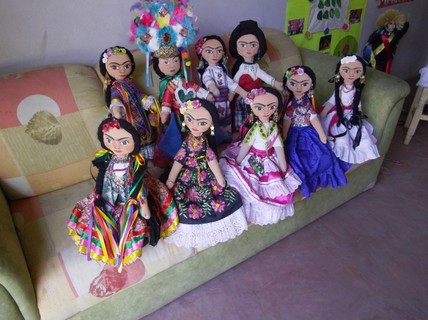
The competitive crafts industry in Oaxaca, Mexico, has a new art form to compete with barro negro and alebrijes, and perhaps more significantly the handcrafted colorfully painted clay sculptures of the Aguilar sisters of Ocotlán. Las hermanas Aguilar have a longstanding tradition of fashioning figures representing women in Oaxacan regional garb. But add the image of famed Mexican artist Frida Kahlo to the mix, and make dolls out of cloth rather than clay, and you have Friduskas.
La Casita Azul Grupo Friduskas Casa Taller de Tradiciones (Friduskas) is a small scale craft enterprise owned and operated by transplanted Veracruzana designer – artisan Dolores Leycegui. In her workshop just outside of the town of Arrazola, near the city of Oaxaca, Leycegui creates, hand embroiders and paints cloth dolls in a variety of sizes, each with the uni-brow facial feature of Frida Kahla. And when she makes male figures, they of course have a likeness to Diego Rivera. In both cases dress is true to local custom, thus wholly representative of the region (and era) which Leycegui seeks to portray in her artistry. The authenticity is remarkable.
The multi-talented Leycegui began sewing at ten years of age. She explains:
“I knew from an early age that I’d end up with a career using my hands, especially sewing and embroidering. For about 30 years I’ve been making embrooidered cloth dolls, and for the past 18 years I’ve have had my own business; initially in Veracruz, subsequently in Chiapas and Michoacan, and now here in Oaxaca. I plan to stay in Oaxaca for the rest of my life. The state is so stimulating for me; at least sixteen distinct indigenous cultures, each with different dress; and there have been so many changes over the generations and the centuries in the clothing styles of both native groups and the Spanish.”
Indeed, with only two years of residence in Oaxaca under her sash, Leycegui has already begun to further tap her creative energies. Her first collection of dolls epitomized the dress of the eight regions of the state. It’s her initial, and naturally still best – selling series. However she’s more recently begun working on a compilation of outfits customarily worn by the women of African – Mexican culture living in the Costa Chica of Oaxaca, near its border with Guerrero; and on a collection from the Porfiriato (1867 – 1911), the era of Mexican president Porfirio Díaz. “For decades to come I’ll have the inspiration all around me,” she explains, “to produce dolls based on the different designs of dress of this one state alone. I travel around the different cultural, climatic and physical regions, and meet with and learn from the people; and of course I also read and look at photographs and drawings of how people of both indigenous and immigrant roots used to dress. Just like we’ve changed the way we dress over the years, so have many of the peoples whose ancestors arrived in Mexico thousands of years ago.”
In addition to her doll collections, Leycegui also makes wood and fabric marionettes, often with the images of Frida Kahlo and Diego Rivera, some in regional dress, and others with different imagery such as Día de los Muertos (day of the dead). Her talent extends even further. Just as a hobby, the collector of vintage sewing machines makes her own machines from clay, papier maché , fabric, and even by using recycled materials, exemplified by the miniature made using a plastic bottle cap as its base. “The bodies for this pair of dolls are made from plastic soda bottles,” she divulges with pride while revealing their hollow undersides.”
Virutally all of her ideas emerge from the deepest recesses of her soul, at the outset as dream revelations. She believes that hers is a pre-ordained mission. She thanks god on a daily basis for setting her on a particular path of continual creativity.
But the founder of Friduskas fulfills yet a further calling, one advanced through secular not spiritual assistance. Leycegui’s workshop is federally sponsored by FONAES (Fondo Nacional de Apoyo par las Empresas en Solidaridad), a branch of Mexico’s Secretary of the Economy. One of its missions is to aid small rural businesses in their efforts to assist specified sectors of the populace in self – determination.
In her own workshop Leycegui conducts classes for the local population and for urban Oaxacans, as well as for tourists to the region, in both making dolls and as an integral part of embroidering. She has coined the phrase “bordaterapia,” (embroider – therapy) which she explains as relaxation and development through the creative art of embroidering.
Through the auspices of downtown Oaxaca’s Casa de la Cultura (house of culture) she instructs a course known as Bordando Jugando y Rescatando (embroidering, playing and rescuing). The thrust of the project is to preserve the art of making traditional, regionally based hand – embroidered products including, of course, dolls. But just as importantly, she teaches Oaxacans of extremely modest means, those with special needs, and single mothers, segments of society often forgotten or allowed to wallow in predicaments often resulting from circumstances beyond their control.
Leycegui’s work with these less fortunate members of Mexican society began several years ago, prior to the birth of her own special needs child. Sebastián is the youngest of her four children. He has Downs Syndrome. “He’s the most beautiful person I know,” she gleams, then continues. “Yes, it was a turn of fate that I gave birth to a child with a condition I had already dedicated my life to helping through providing these classes. This workshop in now for Sebastián, and through it I’m training him to be an artisan, to be self – sufficient.”
Sebastián is symbolic of but one category of beneficiary of Leycegui’s artistry. Others include tourists to Oaxaca wanting to take home a colorful, 100% handcrafted memento of Mexican indigenous cultures; collectors of ethnic dolls of the world; and visitors to Oaxaca interested in commissioning a custom piece of Mexican folk art, with the face of Frida, Diego, or perhaps based on their own self – image.
Alvin and Arlene Starkman operate Casa Machaya Oaxaca Bed & Breakfast (http://www.casamachaya.com). Alvin has written over 250 articles about culture and life in Oaxaca. He assists visitors to Oaxaca to plan their excursions through the state’s central by helping them to plan tours, including for a visit to Friduskas.
 RSS Feed
