This essay augments and synthesizes earlier treatises on modern day, traditional production of mezcal and pulque as green, sustainable industries in Oaxaca. It is restricted to sustainability as it correlates with direct by-products of small-scale commercial mezcal and pulque production. It is beyond the scope of this endeavor, accordingly, to even touch upon the historical utilization of agave, or its current uses unrelated to making fermented beverages and mezcal. It remains a work in progress and is by no means meant to be the definitive or a complete statement on the theme. Finally, the reader should be aware that it does presuppose a basic knowledge of traditional production of mezcal and pulque in Oaxaca.
Growth of the Maguey
Whether Agave angustifolia (espadín, still the most common variety of the plant cultivated for making mezcal), or Agave americana (generically referred to as pulqueros, the varieties used to ferment pulque), these magueyes as they’re locally known, thrive in desolate landscapes, where soil fertility is frequently low and rain is often restricted to a single season. They grow on both steep mountainside slopes and in fields. Naturally the length of time to maturity as well as size and quality of the plant are affected by climatic and other conditions; but the plant does well everywhere within a certain range of elevations in southern Mexico.
Baby agaves harvested from quiotes (stalks) are best planted in beds and watered once or twice a week during dry season. Then, after transplanting into permanent fields during rainy season, they require no irrigation through maturity, which usually occurs six to eight years hence. Fertilizer is not required. Ongoing care and tending is often non-existent, though periodic checking for infestations and weeding is practiced by many growers. Essentially, what the earth offers and the sky delivers are sufficient for producing agave prime for producing both mezcal and pulque.
Quiote, Leaves and Piña Left in the Fields
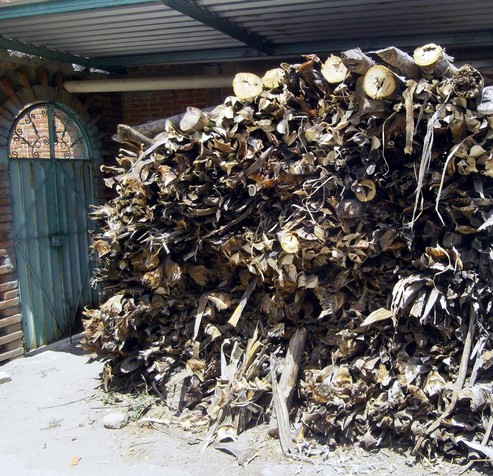
The quiote, while still green, can be milled and mixed with corn masa to make tortillas, yielding a foodstuff with a little more sweetness than the traditional staple. When dried, the quiote is used as a fuel, to heat clay brick ovens for making comales as well as other utilitarian pottery pieces in addition to decorative figures. The dried stalk is also utilized as a fuel for heating comales, grilling meats, boiling water, and a plethora of other uses. It has been used as a construction material, for making “log cabins,” and when covered with a layer of cement can last up to 100 years.
The hollowed out quiote of a number of agave varieties can be used as a musical instrument. The live entertainment which formed part of the presentation earlier this year of the first bilingual edition of Ulises Torrentera’s book, Mezcalaria, Cultura del Mezcal, consisted of a musician playing a series of different trompetas, as they’re known. The sound and form of playing was reminiscent of the Swiss mountain man playing the alpine horn (alphorn, a type of labrophone, bored from softwood) in the old Ricola cough drop commercial. The sound is more agreeable as part of a mixed instrument performance. Nevertheless, the performance exemplified yet a further example of the versatility of the quiote.
The thick, broad leaves of Agave americana, but more commonly the succulent protrusions of angustifolia, are encountered bundled and drying on the rooftops of village homes in agave growing country, particularly in areas where production of pottery is a cottage or more commercial industry. As with the quiote, the leaves are employed as a fuel, sometimes as simply a fire starter, but regularly as a primary “firewood” if you will, for fueling pottery ovens, heating comales, grills and clay pots, and for preparing traditional Oaxacan beverages found in marketplaces throughout the state such as chilacayota, and more often tejate, the corn and cacao based highly nutritional drink of pre-Hispanic origins.
In the production of pulque, at the initial phase of preparing to carve out a well in the heart of the agave for the extraction of aguamiel, leaves are removed. And over the course of ensuing weeks and months as the plant is being tapped twice daily, additional leaves are excised from the living and indeed still green agave. These fresh leaves are almost always used to add flavor to traditional barbacoa, the goat, sheep or beef prepared in an in-ground oven. After each extraction of aguamiel, a layer of flesh from inside the well is scraped away in order to help the plant to “bleed” once more. The scrapings are often used as chicken feed.
When the pulquero has run its course and is no longer viable for producing aguamiel, the heart or piña can be baked along with other unadulterated piñas, to make mezcal. But generally speaking the remaining nutritional value of the piña is so low dictating that it’s not worth the time and effort to further use the plant for mezcal production. On the other hand, with all the leaves completely removed from the agave, and a mere hollow shell remaining, if dried this conical piece of heavy hollow plant product is can be converted into a bongo drum by affixing pieces of tanned hide to each end. Together with the trumpeta we now have half of the prerequisites for a quartet.
Sustainable Mezcal Production I: Baking the Agave
Many palenqueros in Oaxaca use whatever logs are readily available to bake agave, with their purchase motivated mainly by price. However, those who produce the spirit for more commercial and export consumption (as opposed to for a more local population) for a number of reasons are more particular in selecting the type of wood they burn. However, seconds in the forestry industry which are not prime for construction are generally preferred because of the reduced price. This adds to the sustainable nature of mezcal production.
The typical oven is merely a pit dug into the ground, at times lined with clay brick or stone depending on the substratum. The rocks placed on top of the smoldering wood are obtained from small, nearby quarries. A layer of wet fiber, discard from the distillation process, insulates the agave piñas from the hot rocks, thereby inhibiting charring of the bottommost agaves, that is those closest to the rocks. Empty, used grain sacks are ritualistically employed to then cover the mound of agave. The final layer is simply earth. An airtight oven is thus created, at times with logs placed on top of the oven to ensure the earth stays in place.
Once the baking is complete and the piñas and rocks have been removed from the oven, charcoal rather than ash remains in the very bottom of the pit. The charcoal is sold, or used by the palenquero and his family as a fuel for cooking. The charcoal imparts different flavors in grilled meats, not only based on the type of wood from which it has been derived, but from the sweet, caramel-like baked agave.
Sustainable Mezcal Production II: Crushing and Fermenting
The two main methods of crushing baked agave are: (1) employing workers from the local community who use heavy wooden mallets to pulverize the pieces of piña which have been placed in a stone or wood lined “canoe” in the ground; (2) having an employee work a beast of burden to crush the agave after it has been chopped into pieces with a machete and placed in a stone-lined shallow circular pit – the horse, donkey or mule drags a limestone wheel over the agave. In either case, local labor is employed, more so than when more industrialized methods employing diesel or propane fuel and modern stainless steel and related equipment rather than animal or human labor.
Towards the end of fermentation, a thick gooey layer forms on top of the fermentation vat. The substance is used as a sealer during distillation. Whether a copper, or a clay pot and carriso (river reed) still is used, two chambers are sealed with this substance once the lower chamber has been filled with the fermented liquid and fiber.
Sustainable Mezcal Production III: Distilling
Since the wood used to fuel traditional Oaxacan stills (alambiques) of either type does not come in direct contact with the fermented agave fiber and juices, the type of firewood purchased is of less significance than the wood used in baking, the latter selected for its specific properties.
The water used for cooling and condensing is the same water used to clean out the clay or copper pot after the first distillation. It can also be used to irrigate. Accordingly, the same water can be used for three purposes. Finally, the liquid in the alambique remaining at the end of the distillation process, can also be reused to irrigate.
Perhaps the most valuable by-product of the entire process, and which has the greatest number of secondary uses, is the fiber remaining in the still at the conclusion of the first distillation:
· as noted earlier it is used as an insulator between the hot rocks and agave piñas during the baking process;
· it can immediately be used as mulch;
· it can be used as compost after having been left to break down for between six months and two years;
· it can be used as feed for certain farm animals;
· it can be used as a fire starter, a kindling of sorts;
· it can be used as a substratum in commercial mushroom production;
· it can be used to make adobe bricks when mixed with mud and sand.
Epilogue
The stalk, the leaves, the piña; the pit, the wood, the labor; the water and the fiber. Virtually every constituent in each stage of the traditional process of making both mezcal and pulque in Oaxaca is characterized by sustainability. Recylcing and reusing for economic reasons, out of a concern for the environment or simply convenience. It really doesn’t matter. The secondary uses of the materials and means of green production in these two agave-based sustainable Oaxacan industries are remarkable.
Alvin Starkman resides in Oaxaca. He has been a mezcal and pulque aficionado for two decades, helping likeminded visitors to the region and those interested in export or learning more, to get out into the fields and to the various types of palenques to sample, buy and understand more about Mexican fermented and distilled drinks. He co-owns Casa Machaya Oaxaca Bed & Breakfast (http://www.casamachaya.com) and Oaxaca Culinary Tours (http://www.oaxacaculinarytours.com), and uploads interesting information about mezcal and pulque to http://www.oaxaca-mezcal.com.
 RSS Feed
