Casa Machaya Oaxaca Bed & Breakfast Mexico Apartment Hotel
  • Casa Machaya Oaxaca B & B / Apartment / Hotel
  • What Else at Casa Machaya?
  • Space for Children, Another Couple
  • No Surprises
  • Who Are We?
  • Our Guests' Comments
  • Photo Gallery of Casa Machaya Oaxaca Bed & Breakfast
  • Contact
  • Articles About Food & Drink, Crafts, Artists and Other Oaxaca Cultural Traditions
  • Mexico Today (CL) Blog Posts
  • Oaxaca Photo Gallery of One of Our Guests, Christmas 2011
  • Helpful Int'l Tourism Websites
  • Oaxaca Tourism Websites
  • Mexico Today Interesting Articles and News

Agave & Mezcal in Oaxaca, Mexico: Sustainability Revisited

12/13/2013

 
Picture
Alvin Starkman, M.A., J.D.

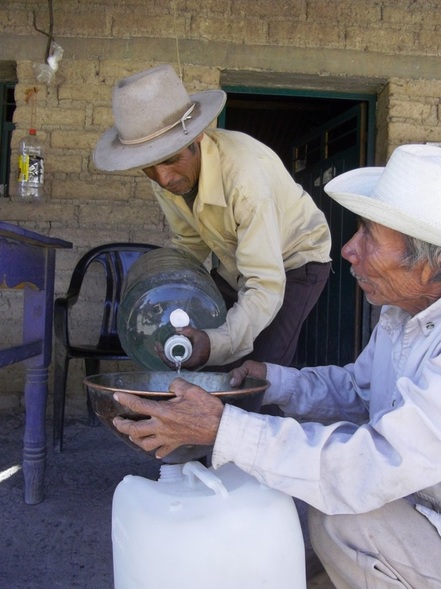
I’ve written about mezcal, pulque, agave and sustainability on a couple of occasions over the past few years.  However the learning curve continues for me, as it should for those palenqueros (as they’re known in the state of Oaxaca; small-scale distillers), mezcaleros and aficionados in Oaxaca who have more than my two decades of experience appreciating and participating in the steps taken to produce mezcal.  We are all students of the spirit, or at least should consider ourselves as such. There are very few experts. Hopefully those who do consider themselves authorities on agave-based fermented and distilled beverages at least keep their minds open to absorbing more.

What I’ve seen, heard and learned over the past year alone, warrants a fresh look at and an expansion of what I’ve previously attempted to convey regarding agave, mezcal, pulque and sustainability.  

This essay, more than previous ones, does presuppose a basic knowledge of traditional mezcal production methods.  But if you don´t have the background, nevertheless read on, since this might just be the impetus you need to visit or return to Oaxaca, and get out into the fields, meet with the palenqueros, and imbibe with a different perspective and a new appreciation.  Mezcal and pulque production are indeed two of the most sustainable industries in all of Mexico. This is due to the environmental respect of their makers, if not by design, then through necessity.

Mezcal has a history dating to 1578 if not earlier, and pulque’s past takes us back a couple of thousand years.  Palenqueros’ and tlachiqueros’ (those who extract aguamiel to then allow it to ferment into pulque) traditions, accordingly, have included inventing and adapting over the course of umpteen generations.  Each small family producer has eked out a modest living; using, reusing, and sustaining his environment as well as himself.  
 
When it comes to the state of Oaxaca where most mezcal (but relatively little pulque) is produced, the diversity in climatic regions, geography and cultures inevitably impacts both the means of
production and tools of the trade involved in growing and harvesting, baking, fermenting and distilling.  Concomitant with the foregoing, then, is the range of sustainability models which relate to the processes. And so it is enough to restrict this essay to Oaxaca, mainly to a radius of no greater than a five hour drive from the capital, since this is my bailiwick. 

At least eight species of the genus Agave are used to make mezcal in the state of Oaxaca.  It’s been reported that most species are represented by upwards of 20 subspecies.  Each subspecies is best suited to a particular micro-climate.  With such a diversity of maguey (as agave is commonly known) it is not difficult to imagine the diversity of regions where mezcal can be produced, and with it the variety of nuances in the spirit.  Where there are fertile, humid river valleys, one subspecies may be best suited, and on the steepest of slopes on rugged rocky terrains some 7,000 feet above sea level, another. 

Agave Growth: Time, Irrigation & Fertilizer

Depending on the species of agave, reproduction may be achieved through germinating seeds, cutting off and planting the baby agaves which grow on the flower stalk, or transplanting runners known as hijuelos.  Best practice dictates watering tiny agaves during the first year or two of growth. If the yearlings are transplanted into fields or onto slopes at about a meter apart during the rainy season, no further irrigation is required for the subsequent eight or more years until maturity is reached.  Greenhousing is not required and generally not practiced. 

If fertilizer is used, it is usually the decomposed feces of farm animals or the composted agave fiber which might otherwise be discarded after distillation.  However the use of any fertilizer is the exception rather than the rule.  
 
While weeding is frequently practiced, it is usually done for only for the first year or two after transplanting into fields or onto slopes.  After this point in the growth cycle of agave, the plant generally loses very little of the nutrients from the terroir.  In fact, it is common practice to plant other crops between the rows of agave known as circos, mainly cash crops which mature and can be harvested once and at times twice yearly.   This enables the grower to sustain himself and gain an income while waiting for his agave to mature and then either be harvested for his own production of mezcal, or sold to a palenquero.   

While there are a couple of pests which can destroy the agave, a program of infrequent yet regular monitoring easily avoids a situation where a crop is wiped out.

Agave Leaves or Pencas:  Though Not Used to Produce Mezcal & Pulque, Have Utility

Agave’s broad, fleshy leaves known as pencas are considered by some to be waste product since they are not directly used to make mezcal or pulque.  However they have multiple other uses in the present, as they have in the past.  
 
In earlier times the pencas were used to produce a green dye.  The sharp point on species such as angustifolia could be broken off and used as a needle, the thin connected fiber as the thread.  The point itself was used as an incising tool, to decorate pottery. 
 
Today, just as in generations past, the pencas are processed into fine fiber and used to make a rope known as ixtle.  The fiber is also used to make floor mats, market bags, clothing, bridles and muzzles for horses and other beasts of burden, and even paper.  
 
While still green, the leaves of Agave americana and other species with large thick pencas are used in the ritualistic preparation of barbacoa de borrego o chivo (sheep or goat cooked in an air-tight in-ground oven).  They are also used to fashion the spoon used in the condensation stage of mezcal
production where clay pot production is practiced.  Two or three green pencas are at times connected to form a trough for this stage in the distillation process, running between and above a series of clay pot stills, delivering water to each.  When the steam rises to the metal receptacle with cool water fed by the trough, it condenses, falls onto the spoon, and exits the pot through a hole, to which a piece of river reed is attached. 

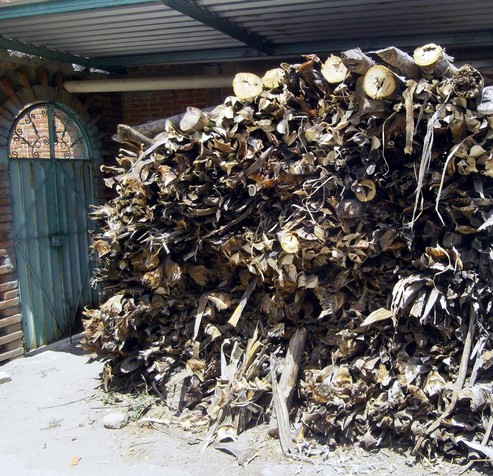
The most common use for dried pencas is as kindling for starting fires and as a primary fuel source utilized in making pottery (rudimentary above ground or open air, or more traditional brick kilns),
or for cooking, most frequently under comals, clay pots and iron grates for preparing, respectively, 
tortillas; moles, coffee, atole, tejate, etc.; and grilled meats and vegetables. 

The Quiote or Flower Stalk:  More than a Reproductive Organ

The flower stalk, or quiote, can extend to more than 20 feet, and reach 8” or more in diameter depending on the variety of agave.  The quiote has been and continues to be used as a musical instrument, similar in form and sound to the alpine horn (alphorn or alpenhorn) in the old Ricola cough drop commercial.  The shape, size and type of conical bore lend to its ability to produce a plethora of sounds, pitches, etc. 
 
When still green, part of the stalk is occasionally ground with corn to make tortillas, providing a bit of natural sweetness to the staple. But as with pencas, the quiote finds its greatest utility when dried.  It is often used as firewood, and on occasion to build log cabins. It’s been noted that if covered with a layer of cement, a home built of quiotes can last up to 100 years. For whatever uses a tree trunk might have, so might the flower stalk of some agave species. 

The Heart or Piña of Agave:  Lifeblood of Mezcal, Pulque & More

The heart or piña of the numerous species of agave used to make mezcal and pulque contains the lion’s share of the nutritional value of the plant.  In the case of pulque, once all the honey water or aguamiel has been harvested from the pulquero (as the species of agave used to produce pulque is generically known), the piña can still be baked, fermented and distilled to produce mezcal.  However, with little nutritional value remaining, it is generally not worth the effort.  On the other hand, the hollowed out base does have a couple of ancillary uses.  The remaining pencas can be
shaved from it, and it can be left to dry.  Hide can be stretched onto the top, and it can be used as a musical instrument, a bongo drum.  Another use is as a rustic, highly functional yet decorative flower pot. The more frequent use is as a log, for fuel. 

Once the piña has been baked, crushed, fermented with the addition of water, and distilled, spent fiber or chaff known as bagazo remains, and is cleaned out of the still.  It has multiple uses.  Its immediate and direct utility in the mezcal making process is to serve as an insulator.  After the firewood and rocks have been placed in the pit used to bake the agave, before the agave is
placed onto the rocks a layer of wet bagazo is placed on top of the rocks.  This inhibits the piñas from burning.   

When dried, the bagazo is at times used as a fire starter.  However more frequently it is used as mulch, and if left to decompose for between six months and two years is used as compost. One palenquero with a sideline business of producing greenhouse tomatoes regularly uses his bagazo as mulch around his tomato plants.  When used as a compost, the bagazo goes right back into the earth to stimulate the growth of the next generation of agave. 

When mixed with mud and sand, bagazo is used to form adobe bricks, having the same properties as adobe made with more traditional materials.  At least two Oaxaca mezcaleros, and likely more, use the bagazo to make labels for their bottles of mezcal for export. 

Wood: Seconds, of Any Tree, or Counter-Productive to a Sustainable Industry

This essay cannot hope to adequately address ongoing arguments regarding what fossil fuel is the safest, cheapest and least detrimental to the environment.  What it can do is put forward factors in support of the use of wood as a renewable resource in the production of mezcal, and let the reader reach a reasoned conclusion. 

Virtually any wood can be used to bake agave and fuel a still.  Of course efficiency, flavor and aroma are impacted. Palenqueros are able to buy seconds in the forestry industry, logs which cannot be used for certain construction purposes because of quality issues.  Some woods burn hotter and smokier than others, and they impart differing flavor and aroma profiles to mezcal.  The point is that palenqueros have choices based upon economic considerations and what they hope to achieve in their mezcal.  

When agave has finished cooking, usually after about five days, and the piñas, bagazo and rocks have been removed from the oven, charcoal, as opposed to ash, remains at the bottom.  The charcoal is sold in grain sacks known as costales, or used as a fuel for cooking. If pine, it is
frequently used in hearths for hand-forging cutlery, knives, machetes and a variety of implements and specialized tools, many of which are employed in the initial stages of mezcal and pulque production.  Since pine charcoal is oxygen rich, it is capable of yielding a hotter heat than most other woods, making forging easier and quicker. 

I previously noted that green agave pencas are at times used to make spoons and troughs. So too are pieces of wood, hewn into shape from the logs purchased to be used as fuel. 
 
Some mezcaleros are actively funding reforestation projects of saplings of their chosen species, so as to ensure a continuous source of fuel in their operations.

The Oven & Crushing Baked Agave:  Crucial Steps Requiring Little Investment

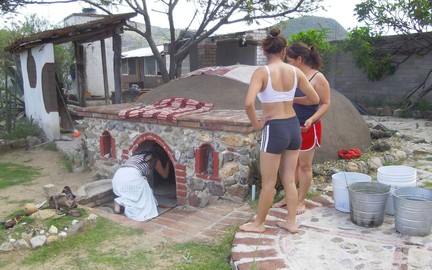
The traditional in-ground oven used to bake agave in mezcal manufacture can be nothing more than a pit dug into the ground.  Depending on the substrate, sometimes no lining is used.  However when reinforcement is required, or the palenquero wants to impart a particular nuance, the oven is usually lined with river rocks. The stones which are used to retain heat during baking are generally secured locally.  

The most commonly employed traditional means of crushing baked agave is using a beast of burden, that is a horse, donkey or mule, to drag a multi-ton stone wheel (usually locally mined limestone
but sometimes a mix of other smaller stones and concrete) known as a tahona, over small maguey pieces contained in a circular shallow stone or stone and concrete enclosure. 

A more rudimentary means which continues to be utilized to crush the baked maguey is using a heavy, hand-hewn, usually hardwood mallet often referred to as a mazo, and pulverizing the fleshy baked plant heart in a usually elongated shallow stone pit or a hollowed-out tree trunk.  In either case the enclosure is known as a canoa, or canoe.  Virtually no capital investment is required by using this means of preparing the agave for fermentation. 

Fermenting Pulverized Agave:  Nothing Goes to the Scrap Dealer

Crushed maguey with the addition of requisite water can be fermented in virtually any receptacle as long as it reasonably retains the liquid and does not lead to imparting an undesirable flavor or aroma to the mezcal.  While pine slatted tanks are most commonly used in and around the central valleys of Oaxaca, other wood is also employed.  However, these above-ground wooden tinas as they’re known, are far from the only options.  At times a pit is dug in the ground, and once again depending on the substrate, either nothing more need be done to it to create a fermentation tank, or it can be lined with stone or wooden boards.  

In Sola de Vega and Matatlán I’ve seen enormous hollowed out tree trunks and stone lined pits respectively used as fermentation vats.  In both cases these were vintage and no longer operational, although presumably in certain locales they both continue to be used.  Similarly, yet still employed today in some parts, hides and organ linings provide sustainable secondary uses for animal parts, imparting unique nuances to mezcal.

Large plastic barrels and buckets, concrete and / or brick tanks, sterilized oil drums, and even the metal shells of broken down washing machines are used to ferment. 

The capa which forms on the top of the filled fermentation vessels even has a use, to seal together the upper and lower chambers in clay pot production.  It is similarly utilized with copper distillation, sealing each part of the copper apparatus to the other; the large encased pot to the top vessel, the
top vessel to the tube extending across to the tank, and that tube to the immersed serpentine. 

Water and The Still 

The water used in mezcal production comes from diverse sources. Included among them, are rivers and streams with or without filtration, trucked in water which is filtered, and spring water. Of
course quality is key for fermenting and mixing with mezcal to adjust alcohol content.  However, for use in the still for condensation, it is of virtually no importance.  
 
In terms of distillation, sustainability viz. water is noteworthy.  In copper stills, water is left in the tanks, circulated, or kept running so that it is continuously changing and kept cool to better facilitate
condensation.  In all cases it is reusable; for irrigation, for cleaning the still, and for as many other uses as imaginable.  Similarly once distillation has been completed the runoff can be reused, usually for irrigation.  Clay pot operations tend to be in regions where there is an abundance of water, and hence water is often not recirculated, but rather continuously flows into and then out of the condensation vessel, exiting to be used to irrigate. 
 
Copper still mezcal production requires a significant capital outlay, but the casings enclosing the copper are generally constructed of clay brick or stone, with their mortar often consisting of
mud.  Cost is somewhat reduced if, for example, the serpentine is immersed in an otherwise unusable washing machine outer metal shell rather than in a brick housing. For clay pot production, the pots are produced locally, and once again the casing is usually brick or stone and mortar.  The mortar is often a mix of mud and / or cement and / or, once again bagazo. 
 
Sustainability in Mezcal and Agave-Related Mexico Industries Remains Vital

Oaxaca is one of the poorest states in Mexico.  Recycling is practiced mainly out of necessity, rather than out of a concern for the environment.  In the mezcal, pulque and other agave-related industries, unless otherwise stated each instance of sustenance and recycling noted continues today, certainly in Oaxaca if not in other states in the republic. Palenqueros and mezcaleros, tlachiqueros, campesinos, and virtually all others integrated into these livelihoods, continue to invent and adapt to their surroundings and to the vicissitudes of life, producing mezcal, pulque and the almost innumerable variety of products made using the fine agave fiber.  It is hoped that at least this aspect of their way of life will continue, in the future more so out of an appreciation for the environment than out of economic compulsion. 

Alvin Starkman operates www.oaxaca-mezcal.com, and is the co-author of the most detailed and compresensive mezcal tasting wheel on the market today.  Alvin frequently takes visitors to Oaxaca, as well as Oaxacans, into the central valley villages and further abroad to educate them about the production of mezcal and pulque.  He also consults to those interested in importing mezcal to their home countries. He can be reached at [email protected].


Mezcal's Future on the World Stage: Complexity & Nuances Unrivalled

11/10/2013

 
Imagen
Alvin Starkman, M.A., J.D.*

Mezcal’s star has risen to new heights with each ensuing year since about 2007, with no end in sight to its increasing popularity, export to new markets, and consumption.  Knowledge of the diversity of Mexico’s agave-based spirit is finally starting to reach consumers outside of the particular region where it is distilled.  Mezcal is en route to potentially becoming the globe’s most complex spirit, rivalling single malt scotch whiskies, with its innumerable flavor and aroma nuances.

Mezcal aficionados, as well as those who have traditionally coveted a favorite tequila, scotch, brandy or other spirit, have begun to yearn for something new to stimulate the palate on a continual
basis – just as oenophiles who appreciate or collect wines from certain regions, varietal types, and methods of manufacture.  Mezcal offers a similar range.  
 
Consider the number of species and sub-species of agave (popularly known as maguey) used in production, the length of time it takes to grow a plant to maturity, variations in climatic conditions
in those intervening years, the range of growing regions, the diversity of tools of the trade and means of production, and finally the plethora of infusing and aging factors.

“The universe of spirits began to change when the word designer, having become an adjective, attached itself to the word vodka.  Then, some of the most famous names in the world of distillation became better known for their ready-to-drink confections, misleadingly known in the United States as malternatives.  Now a new generation of consumer faces a choice between drinks that come from nowhere, taste of nothing much, and have a logo for a name;  and drinks that come from somewhere, have complex aromas and flavours, and may have a name that is hard to pronounce.

“Such drinks reflect their place of origin.  They have evolved.  They have a story to tell. 
They are good company, and they require something of the drinker in return; that he or she experiences the pleasure of learning to drink.  Real, evolved drinks begin as the gift of God.  They are grown, whether from grapes, grain, sugar cane, or, for example, the agave plant. 
They arise from their own terroir:  geology, soil, vegetation, topography, weather, water, and air.”[1]


Jackson goes on to boldly assert that the most sophisticated of real drinks are the brandies of France and the whiskies of the British Isles, the most complex of the former being the cognacs and armagnacs, and of the latter those of Scotland and Ireland. [2]  It would have been hard to mount a convincing argument against the proposition in 2004;[3] but a decade later, with more mezcal producers and exporters realizing the spirit’s capability of impacting the world stage, and many lobbying for a new form of federal regulation[4] which would enable artisanal mezcal distilled in more states in Mexico to reach foreign markets, a case can be made for crowning the agave-based spirit if not now the king of sophisticates, then the distillate with the most promise to dislodge its top rivals. 

Diversity of Agave Species Used in Mezcal Production

More species of the genus Agave are used to make mezcal than the number of species of any other plant material utilized in the production of other spirits.[5]  This fact in and of itself provides a convincing starting point, it is suggested, to support the proposition that mezcal has the capacity to become the spirit with the greatest number of flavor and aroma nuances. 

Determining with certainty the number of species and sub-species in the Agave genus[6] and how many are represented in Mexico is a difficult task.  Similarly, what percentage of the range of agaves in the country is used to manufacture mezcal in which states is a moving target.  While the answers are not germane to this essay, the fact of the discrepancy in the figures should be acknowledged prior to proffering any numbers. And it is trite but nevertheless worthy to note that botanical classifications are by their nature fluid.[7]

Of a total of 200 species of Agave, 150 are represented in Mexico (70% of which are endemic to the country).  About 20% of the species are used to make mezcal in 26 different states
throughout the republic. [8]  An average of 20 distinct varietals of each of those species is used to
make the spirit. With at least eight species used to make mezcal in Oaxaca alone, the number of flavors and aromas potentially available in this one state is staggering, without considering other influencing factors. Only the grape can claim a greater number of varietals.  When it comes to
barley, it has been suggested that only one species is cultivated for use in making single malt scotch whiskies.[9]

Just as there are blended whiskies, and wines that combine different grapes, so too are there mezcals which are made from two, three, or four different types of agave. In Oaxaca they are known as ensambles, or more commonly mezclas.  But they rarely if ever leave Mexico, and usually not even the region in which they are produced.  It is no different than when one hears that the best whiskies do not leave Scotland or Ireland, or that the best wines do not leave France or Australia. However, whereas in the case of these whiskies and wines it may be just myth or legend, in the case of mezcal it is a fact that the best spirits remain in Mexico, if not the region of production.

No essay on mezcal would be complete without an acknowledgement of the part that tequila plays in the world of agave-based Mexican alcoholic beverages.  However, there are some important distinctions to be made.  By law tequila can only be produced using one type of agave, Agave
tequilana
Weber (commonly known as blue agave).[10] Thus, one cannot produce a mezcla
with tequila, since the manufacture of the spirit is restricted in that only Agave tequilana Weber can be used. Fabrication of tequila is limited to Jalisco and circumscribed regions of four other states. Furthermore, artisanal production reaching foreign markets is relatively uncommon. 

Climate, Geography & Related Growth Concomitants as Contributors

Agave angustifolia Haw (commonly referred to in Spanish as espadín) remains the varietal of agave
most commonly used to manufacture mezcal. It, as well as many other species of the succulent, takes an average of nine or ten years to mature, often much longer, and generally only then is it considered prime for harvesting.  Silvia Philion Muñoz, co-owner of downtown Oaxaca mezcal tasting room Mezcaloteca, notes that no other raw material used to make a spirit takes as long to mature, and that the cumulative effect of a decade of changes in surrounding vegetation, rainfall, and soil
composition contributes to mezcal’s unmatched complexity.  The longer the plant grows, the more it absorbs from its immediate environment and annual fluctuations.  “Each small batch of approximately 200 liters,” she believes, “is unique in that its flavors and aromas cannot be repeated.”

Different species of Agave are better suited to different elevations, levels of precipitation, number of days of sunshine, soil conditions, and so on.  But this is not to say that several species are not highly adaptable to wherever they are grown.  Espadín, for example, does well when cultivated on both flat plains containing rich black earth, contiguous with humid river valleys such as around the city of Sola de Vega, and on the steepest of inclines at well over 6,000 feet above sea level, such as on the deep amber iron oxide rich slopes surrounding the town of San Juan del Río, both in the state of
Oaxaca:

“Magueyes thrive in areas with arid climate, thin soil, high temperatures and little precipitation, and especially at an altitude of between 1000 and 2000 meters above sea level, where the climate is also temperate.  Known locally as either magueyes or agaves …. these hardy plants can be found on plains, in deep river ravines, on dunes by the seashore and on mountain peaks at altitudes of over 3000 meters.”[11]

As noted, mezcal is produced in 26 states.[12]  The geographical diversity and consequent climatic differences are as significant if not more profound in affecting the characteristics of mezcals, as
those in Scotland virtually always touted as influencing particular single malts.[13] 
Oaxaca, where most of the nation’s mezcal is produced, has extraordinary variations in topography, elevation, temperature and precipitation, not encountered elsewhere in Mexico.[14]

While many distillers, in particular those who own large, highly industrialized plants, use water trucked into their facilities that is processed through sophisticated filtration systems, and others (i.e.
some who own more traditional distilleries) draw water from rivers in close proximity to their operations, many producers use pure spring water, the character of which varies greatly depending on the particular micro-climate where the distillery is situated.[15]

In many cases the agave is not harvested from large, flat expanses of land with uniform soil and precipitation. For example, it can be cut from both sides of a river valley, with the agaves on
each side yielding a mezcal with a different nuance.  The sun impacts one slope differently than the other.  Similarly, rain is not uniform because of wind direction. The plants at the top of a hill receive a different amount of precipitation than those at the bottom, and similarly the soil and surrounding vegetation will vary, further impacting final flavor and aroma.

The Distiller and the Grower

Most distilleries in Mexico are owned and operated by families, the members of which have been carrying on a tradition which has been passed down from generation to generation.[16] 
Their recipes begin not with how and for how long they bake their agave, but rather what agave they use, as well as from where, how and when it is harvested.  

In modern times, more and more agave species are being used to make mezcal, in large part impacted by consumer demand.  And while the use of wild agaves that have not traditionally been cultivated[17] is now in vogue, it is something that has been occurring for centuries, based upon what wild species have been readily available for harvesting.  Although it has been noted that species are adaptable to different environments, magueyes generally have their preferred micro-climates. Accordingly, a family that lives in one part of the state will inevitably produce a mezcal
which is somewhat different from a family producing in another part of the state, based upon the species and sub-species available and best suited to the region, the topography, and so on.  

Distillers do not always own the land from which their agave is harvested. They may pay a landowner for the privilege of using the terrain to plant, weed and finally harvest the agave; they may buy agave outright from growers or communities willing to part with communally owned
maguey; or they may have some other arrangement.  In between circos (rows) of agave, the
landowner may plant any number of other crops, and change which ones he grows several times over the period of time that the agave is growing before reaching maturity.  Crops could be corn,
beans, squash, chickpeas, alfalfa, to name a few, each impacting and contributing to the uniqueness of the terroir where the maguey is grown. 

With espadín and most other cultivable agaves used in mezcal production, at maturity a quiote
(flower stalk) appears.  The quiote is then cut off, and the plant remains in the field for anywhere from a couple of months to a year depending on local climatic conditions.  The distiller / buyer chooses when to harvest, and that decision impacts upon the ultimate flavor of the spirit, with plants allowed to stay in the field longer yielding mezcal with stronger notes of the particular agave.[18]  

Time is a key factor in numerous other respects insofar as determining nuances adopted through distillation.  Each distiller has his or her own idiosyncratic beliefs: how long to bake the agave using what kind of firewood, and then how long to let it sit exposed to the air after baking, before further
processing. Regarding the latter, a palenquero (as small batch distillers are known in Oaxaca) just outside of the town of San Lorenzo Albarradas, lets his Agave potatorum (commonly referred to in Spanish as tobalá) rest in a mound for a couple of weeks, after it has been baked in a traditional in-ground oven, until a green mold forms on the exterior.  Only then does he mash and ferment it. He believes that this enhances the flavor. Most other palenqueros have not heard of this; but his
tobalá
without a doubt has a remarkable, grassy/herbal taste. Similarly, while most distillers do not pour water into the in-ground otherwise airtight oven, through a hole in the top, while the agave is baking, some do, especially during hot weather months, claiming that this reduces charring of the maguey – necessarily impacting flavor and aroma. Some palenqueros have not even heard of this step, while some of those who have, give different reasons for the practice and indeed use it all the time, regardless of ambient temperature or other considerations. 

Another variable regarding time is how long to ferment, determined in large part by prevailing climatic conditions.  And of course, if mezcal is made true to its original formulation dating
back centuries,[19] only natural yeasts derived from the environment are used to ferment.  Each
micro-climate has unique yeasts.  In fact, those yeasts change on a seasonal basis, further impacting flavor nuances.[20] 

How each producer distills is also unique to his facility and likely his family history of making mezcal: when to take off the punta (head) and similarly dealing with the cola (tail), adding mezcal to the tepache (fermented liquid and fiber) in the copper kettle for the first distillation, whether to distill twice or for a third time, if the water used in the traditional condenser is kept cool through circulating it or by continuously using new cool water, and so on.  No two traditional (clay or copper pot) distillers use exactly the same recipe unless they are close family members.

Means of Production and Tools of the Trade

The composition, location, and to lesser extent size of fermentation vessels affect finished product. Industrialized operations use stainless steel, but in traditional distilleries some continue to ferment in
animal skins, although most use wooden slat vats, the composition of which varies depending on the wood readily available in the particular part of Mexico, thus further contributing to flavor nuances.  Most tubs are above ground, but some consist of rectangular shaped pits dug into the earth and lined with wooden planks.[21] Some use tanks of clay brick covered with concrete, and some even use plastic drums.[22] There are additional variations on the theme, each impacting the mezcal that ultimately drips out of the spigot of the condenser. 

It is suggested that the equipment used to crush, be it a beast of burden pulling a tahona (stone wheel) over the agave, a mallet used to pulverize it in an in-ground stone-lined or in an above-ground planked wood canoa (canoe), or stainless steel cutting blades, does not impact the finished product.  Some, however, would disagree, especially traditional Mexican cooks who steadfastly maintain that grinding corn, chiles, or other foodstuffs on a stone metate produces a far superior end result than when ingredients are taken to the local mill or pulverized in an electric blender.  On the other hand, how finely the baked agave is mashed, regardless of by what means, inevitably determines the speed and extent to which environmental yeasts interact with the maguey,
and thus, affects flavor and aroma.  
 
While Scorpion Mezcal’s owner Douglas French states that there are four basic production systems which affect mezcal’s flavor (primitive, traditional artisanal, traditional craft production and industrial), it is suggested that a continuum of means of production exists, together with a range of different tools of the trade used in each.  The most commercial and industrialized production methods and tools employing steam, diesel fuel, diffusers, autoclaves, stainless steel and so on,
are at one end,[23]  and the most rudimentary, using 100% locally produced tools, firewood, no electric or gas powered pumps or motors, and only human labor, are at the other.[24] 

In-ground ovens differ greatly as well, in diameter, depth, and lining material if used at all (i.e. brick or stone, or in some instances depending on the integrity of the substratum, simply earth).  Variables in firewood and the use of water during baking have already been noted.  French uses a brick chamber on top of which agave is piled, with steam running through a series of tubes
underneath.  Enrique Jiménez who produces Mezcal del Amigo, Amores, Ultramarine,  La Muerte, and Herencia del Mezcalero among other brands, uses a similar method for some of his baking, or rather in this case steaming. Smokiness is therefore reduced since there is no interaction with firewood. 
 
All spirits were initially distilled in small batches using a vessel which appears to be somewhat in the shape of a cooking pot or kettle.  Traditional mezcal (as well as single malt scotch whisky) production continues to be made in this way. 

Size, shape, and composition of the distillation vessel vary to a significant extent in the production of mezcal, though there is a standard size and form of copper apparatus traditionally employed in the state of Oaxaca.  Such differences affect flavor, richness, and weight of the spirit.  Jiménez uses a multi-chambered copper still, which according to the federal regulatory body COMERCAM (Consejo
Mexicano Regulador De La Calidad Del Mezcal, A.C.
),[25] produces a double-distilled product
through a single process.  He then employs a second unit, a copper column still, enabling him to produce a triple-distilled mezcal in two as opposed to three steps.  

The single unit clay pot still and condenser produces unique flavor and aroma nuances, as distinct from when copper, wood, galvanized metal and / or stainless steel are used, even though in
most cases the condenser contains a metal cone.  The composition of the clay pot (olla de barro) necessarily differs based upon the characteristics of the earth used in its fabrication, which
varies depending upon the region of Mexico where the pot is made.  Accordingly, the mezcal produced using ollas from one area of a state has properties distinct from that produced somewhere
else. 
 
In one particular Oaxacan palenque, the producer, who distills for different export labels, operates both copper and stainless steel stills, enabling him to impart different tones to his mezcal through using one apparatus versus the other. Another Oaxacan producer in Sola de Vega uses a rudimentary in-line quadruple clay pot still arrangement.  He also employs a very unique still configuration made of sterilized oil drums, two of which both heat and begin the condensation process, and a third which is used for strictly cooling.  Copper tubing is also utilized.  And in Michoacán, a combination of galvanized metal and wood is used in still fabrication; the condenser is part of the single unit.

Aging, Infusing and Pechugas

Mezcal may never be identified by the use of different barrel types, cask strengths or wood finishes like single malt scotches, for two main reasons.  Firstly, it does not have to, since the other variables impacting flavor and aroma are so numerous.  On the other hand, Jackson has pointed to the diversity of malts having greatly increased consumer interest in whiskies of all types,[26] yet scotch continues to be marketed on the basis of aging mediums. Secondly, lobbying against aging has taken a fairly strong foothold, at least in the state of Oaxaca.  Both Philion Muñoz and Torrentera
attempt to convert novice mezcal aficionados and in so doing denigrate the concept of and value in aging of any type; and they seem to give short shrift to infusing.[27]  French, on the other hand, appears to be at the vanguard in terms of experimenting with aging mezcals made with different agaves. 
 
The potential in this area, however, lies in wait.  Barreling of mezcal is still in its infancy, and in fact only began in earnest, at least in the state of Oaxaca, in the second half of the 20th century, when oak barrels began to be used not for the purpose of imparting flavor, but rather as a more convenient method for transport and storage, as compared to the earlier practice of using clay receptacles known as cántaros. Widespread storage in clay, imparting its own nuances, will likely never return,[28] but barreling does show potential.

The use of barrels made from French, Canadian, and American oak is commonplace, as is charring their interiors.  Distillers often buy French wine and Kentucky bourbon barrels.[29]  It may just be a matter of time and marketing until mezcal becomes more identified with in what it has been aged, rather than current practice of noting only age.[30] Infusing mezcal with a strip of baked agave, fruit, herbs including citrus leaves, as well as the famed gusano (worm)[31] each imparts a variety of different flavors. However, unless care is taken to alter the agave’s character with only a hint of those essences, the favor of the agave becomes masked, or perhaps better put, bastardized.[32] 

While on the one hand infusing appears to be a relatively recent phenomenon within the context of Mexican agave distillation, a more subtle altering of a particular mezcal’s nuance through adding a foreign substance to the still during the second (or a third) distillation, dates to the 1940s, if not earlier.  Mezcals so changed have been and continue to be highly coveted.

Pechuga means breast, and in traditional mezcal parlance it signifies a mezcal which has had a chicken breast inserted into the still for the second or third distillation, dangling so that vapor passes up and over it before condensing, imparting a fuller body and different aroma and taste.  History reveals that serving pechuga may have originated with the honoring a particular festive occasion.[33]  Many believe that it continues to be used for such occasions.  And even if not, its price on the open market would seem to suggest its special status.[34]

There are numerous incarnations of what is generically now referred to as mezcal de pechuga.  Turkey or chicken breast, deer meat and rabbit meat are known to be used in making the spirit, and no doubt there are many other animal proteins which are employed. Sometimes the protein is combined with a series of seasonal fruits, together with herbs and spices, with some of the additions placed in the bottom of the still vessel rather than hanging with the animal meat.  And sometimes pechugas are made sans a meat protein, though it is suggested that perhaps they ought not to be deemed pechugas.[35] Pechugas are gingerly made so as to retain the character of the agave as the principal flavor and aroma, and merely add a subtle hint of the products used to alter it.  Pechuga thereby produces an entirely different range of flavors and aromas without diminishing the original nuance created by other factors as noted above.

If Not Now, How & When Will Mezcal be Recognized as the Most Complex Spirit?

Aficionados who live in a particular mezcal-producing region of Mexico, and have access to mezcals made in other regions and states, are cognizant of the plethora of nuances of their national
spirit.  The issue remains how to enlighten the rest of the world. There are relatively few small batch exporters, most of whom are not even from families with a heritage steeped in making mezcal.  Many of them, together with COMERCAM, have interests which, it is suggested, lie in maintaining the status quo and not amending the rules to permit the hundreds of rural families who have been producing superb spirits for generations, access to the export market.[36]

Santiago Matatlán is located an hour’s drive outside of Oaxaca.  It is the self-proclaimed “World Capital of Mezcal.” Subsequent to the formation of COMERCAM early in this century,[37] the number of palenqueros in and around the town dropped by about two thirds, in large part because of the
regulatory body’s strict rules, extensive paperwork and cost of membership, all required to produce mezcal for export which meets its prerequisites.  Small artisanal producers are being squeezed out of the marketplace despite their contributions to mezcal’s diverse offerings and their rich cultural heritage. Big producers and exporters succeed in large part because of the romanticism associated with traditional production by rural folk.  

Small producers throughout the country are in danger of extinction,[38] unless the rules of the game are changed, unless there is a uniform labeling system which respects and promotes not only
regional variation, but also the nuances unique to a particular micro-climate – yes, as in Highland, Lowland, Islay, Speyside, Campbeltown, and their sub-regions, the diversity of peats and seaweeds, and spring waters cascading their way down from snowy mountains over rocks and up from springs, and all the rest which has, in Jackson’s opinion, elevated single malt scotch whiskies to their current status. 

It is suggested that all spirits produced anywhere in Mexico using 100% agave should be called mezcal,[39] and be able to be exported throughout the country and further abroad,[40] and that any spirit with anything less than 100% agave should not be called mezcal.  

There are indeed exporters who have mezcal produced using different agave species, and note on their labels the popular names of the species and the villages in which they are produced.  But that is not enough. Their numbers are small, and the interests of too many lie in maintaining a miniscule complement of exporters.  The status quo works to their advantage.  As long as agave can be trucked in from a distant region of a state, it is not enough that a label notes where a bottle
of mezcal was distilled.[41]

Mezcal has immeasurable, unbounded potential.  But steps must be taken to celebrate its miscellany in flavor and aromatic nuances, and promote its complexity, much more so than is presently occurring.  Access in foreign markets to more varieties, with the spirit appropriately identified and distinguished based on the factors enumerated above, is essential.  Without it, can mezcal rightfully take its place alongside or atop its major rivals which enjoy international exposure?

With such biological and cultural diversity, mezcal produced in the furthest reaches of Mexico should be available throughout the globe because of what it offers, and the story it tells.   Otherwise, not only will opportunity be lost, but a grand part of the history and heritage of Mexico may be permitted to slide into obscurity.[42] 

The world of spirits needs and deserves a competitor for single malt scotch whiskies.  Let the industrialized agave-based spirits, and indeed the vodkas of the world fall into the melting pot of
inebriants.  Mezcal can realize its deserved and unbridled capacity, by resisting its homogenization masked under the guise of logos and labels, marketing motivated names, and ulterior, agenda-motivated regulatory paternalism. 

*Sincerest thanks to Dr. Ronda Brulotte and Clayton Czczech for their comments on a previous draft.  All shortcomings in this essay are the author’s alone.

Alvin Starkman has written over 30 articles about mezcal, pulque and Mexican craft beer. His expertise lies mainly with mezcal production in his home state of Oaxaca.  He frequently takes visitors to Oaxaca into the hinterland to learn about mezcal and pulque for their personal
interests or to assist in their export aspirations. He operates
Oaxaca Mezcal &
Pulque
, and Oaxaca Culinary Tours with Chef Pilar Cabrera Arroyo.

  
[1] Michael Jackson, Complete Guide to Single Malt Scotch (Philadelphia, PA: 
Running Press, 2004), p. 37.
  
[2] Ibid., p. 37.
  
[3] The year of Jackson’s publication, ibid.

[4] See, for example, the highly opinionated treatise by Ulises Torrentera, Mezcalaria 
Cultura del Mezcal – The Cult of Mezcal
(Oaxaca, MX:  Farolito Ediciones, 2012) and the plea contained in Catarina Illsley Granich, 2010, “Keys to Savoring Mezcals,” Artes
de México
, 98 (Mezcal Arte Tradicional): 84-87.
  
[5] Douglas French of Scorpion Mezcal states that no other distilled spirit category has 30 different base materials.  On the other hand, Clayton Szczech of Experience Tequila indicates that schnapps
and eau de vie in Europe are made from every fruit imaginable, as well as fruit pits, tree bark, etc. 
  
[6] Agave is one of eight genuses in the Agavaceae family, the others being Yucca, Beschorneria, Prochnyanthes, Furcraea, Herperaloe, Polianthes and Manfreda. 

[7] Reclassification is similarly not foreign in taxonomic discussions regarding barley, the grain exclusively malted to produce single malt scotch whiskies.
  
[8] Ana G. Valenzuela and Marie Sarita Gaytán, 2012, “Sustaining Biological and Cultural Diversity; Geographic Indications and Traditional Mezcal Production in Jalisco, Mexico,” Revue de
ethnoécologie,
2: 1-18.  A commentator in a video produced for Los Danzantes mezcal states that 39 species are used to make mezcal, French pegs the number at 30, while Silvia Philion
Muñoz, co-owner of a downtown Oaxaca tasting room, Mezcaloteca, puts the number
at 25 – with sub-species of course.  
  
[9] Barley is at times imported to Scotland from other countries for producing single malt scotches, thereby augmenting diversity in the finished spirit, and of course the diversity of scotches is significantly impacted by the different micro-climates in Scotland, well documented and noted by distillers in promoting their products. 
  
[10] Since tequila can be made with 49% outside sugar sources (as compared to 20% for mezcal), in this way it can achieve some added flavor diversity, although only tequilas (and mezcals) made with 100% agave are considered the real deal. Tequila Don Julio’s new entry into the marketplace, a
silver or blanco añejo (Don Julio 70 Añejo Claro), is perhaps evidence of tequila’s struggle to contend with a growing interest in different agave-based flavor nuances more readily achievable with mezcal.  On the other hand, Tequila Ocho does produce at different ranchos each with a distinctly different surrounding terroir, though its tools of the trade appear rather uniform and sophisticated based upon a review of its website, http://www.ochotequila.com. 
  
[11] Abisaí Josué García Mendoza, 2010, “The Geography of Mezcal,”  Artes de México, 98 (Mezcal
Arte Tradicional): 82-83.
  
[12] Ana G. Valenzuela and Marie Sarita Gaytán, ibid.  Mezcal is not identified as such in several states, though often produced with 100% agave. Other agave-based spirits in Mexico include bacanora, sotol, raicilla,  sikua and distilados de agave. 
  
[13] Scottish single malts are categorized into only five or six whisky producing regions. 
  
[14] Juan Arturo López Ramos makes a convincing case for the proposition in Oaxaca,
Cuna y destino de la Civilización América
(Oaxaca, MX: Fundación Cultural Fernández Pichardo, 2010).

[15] For example, one San Juan del Río, Oaxaca, distillery located high up above the town, draws its spring water from five kilometers further up the mountainside. The water used creates a unique flavor profile not found in the mezcals produced by the town’s other distillers.

[16] According to Torrentera, agave has been cultivated in Mexico for upwards of 8,500 years (ibid., p. 50), although best convincing evidence suggests that distilling (as distinct from fermenting) did not being until the arrival of the Spanish, either in the second half of the 16th century or in the 17th century, depending on the source relied upon.  Curiously, the cultivation of a barley prototype also dates to the same era, shortly after hunters and gatherers in the fertile crescent of the Middle East began settlements (Jackson, ibid., p. 25).  A brief, objective summary of the case for pre-Hispanic distillation is found in Patricia Colunga García Marín, Daniel Zizumbo Villareal, Fernando González Zozaya, Ángeles Olay Barriento, Rafael Platas Ruiz, Mariza Cuevas Sagardí and Laura Almendros López, 2010, “Mezcal:  A Pre-Hispanic Mexican Art?,” Artes de México, 98 (Mezcal Arte Tradicional): 87-88.
  
[17] Experimentation is proceeding at a feverish pitch to grow these traditionally wild agave from seed, to work with hybridization, etc., all to satisfy growing demand and capitalize on greater
consumer palate sophistication. In addition, there is a concern that some sub-species are becoming endangered as a result of overharvesting. Some distillers foresee an exacerbation of the problem and are attempting to address it.  Questions remain, however, as to how to appropriately deal with shortages, ecological impact and related matters, if export to foreign markets continues at its current pace. 
  
[18] In Oaxaca, a mezcal made from agave which has been left in the field for upwards of a year, is known as capón, or “castrated.”
  
[19] As exemplified by both the single unit clay pot still and the two part copper still and condenser unit.
  
[20] See Araceli Minerva Vera Guzmán, Mercedes Guadalupe López and José Luis Chávez-Servia, 2012,  “Chemical Composition and Volatile Compounds in the Artisanal Fermentation of Mezcal in Oaxaca, Mexico,” 11(78): 14344-14353, for the culmination of research in Tlacolula and Matatlán, Oaxaca, which deals with differences in fermentation depending on season (Spring and
Fall highlighted). 

[21] For example, at the distillery of Mezcal Don Mateo in San Miguel del Monte, Michoacán.
 
[22] Where full disclosure prevails, the free market ultimately determines the popularity of mezcales produced using plastic receptacles in which to ferment.  The same holds true regarding stills made from sterilized oil drums, referenced further along in the body of this essay. 
  
[23] For example, at Mezcal Benevá, located between the city of Oaxaca and Tlacolula de Matamoros, along the same stretch of highway as Zignum (of Armando Guillermo Prieto), the new Casa Chagoya facility, and just off the highway at San Lucas Quiavini a yet-to-open government sponsored plant.
  
[24] For example the palenques of Felix Ángeles Arellanos of Santa Catarina Minas, just outside of Ocotlán de Morelos, and of the Sánchez  Cisneros family of Pueblo Viejo, a tiny hamlet an hour’s drive from San Juan Mixtepec, in Oaxaca’s Mixteca Alta.  Is a distillery which deviates from this “primitive” model only in that it crushes it’s baked agave using gas or electric powered machinery, still considered to be the most rudimentary, or is it one step over along the continuum?   
  
[25] COMERCAM oversees production and certification of mezcal for domestic sale and international distribution with a view to maintaining quality control in the marketplace.
  
[26] Ibid., pp. 7 and 21.
  
[27] Although credit must be given to each of them for their efforts at educating both novices and spirits aficionados alike.

[28] Though still used in conjunction with the odd distillery. And storage in animal skins has all but
disappeared.

[29] Barrels are often imported to Mexican distilleries broken down, and then re-assembled by specialists at the trade, known as barriqueros.
  
[30] Although promoting mezcal by noting on the label that it has been aged in Kentucky bourbon barrels is conventional (for example, La Muerte’s añejo label notes “5 YEAR AÑEJO KENTUCKY BOURBON BARRELS.” 
  
[31] Actually a larva which infests the agave and certain nearby plants.
  
[32] As many assert is the case with barrel aging.
  
[33] See the author’s article about the origins of pechuga, found here:
http://www.oaxaca-mezcal.com/2/category/mezcal%20de%20pechuga%20oaxaca/1.html.
  
[34] Pierde Almas and Mezcal del Maguey brands sell in the state of Washington, known for its high liquor taxes, for in excess of $200 USD for 750 ml, and Pierde Almas made with rabbit meat for almost $400 USD.
  
[35] Perhaps more appropriately labeled as vegetarian pechugas.
  
[36] It is cautiously suggested that a recently initiated federal program may be making inroads towards change.
  
[37] The distillery accreditation process began in 2003, but the organism was actually formed in 1997. 
  
[38] Subject to the progress noted in the previous footnote.
  
[39] Save and except for tequila; and if the makers of other 100% agave based spirits deem it advantageous to them to retain their popular names, then those spirits as well, subject to their right to switch over and onto the mezcal bandwagon.
  
[40] Subject to complying with reasonable prerequisites aimed at maintaining quality control while at the same time promoting mezcal’s complexity and innumerable flavor and aroma nuances.  It is beyond the scope of this essay to suggest detailed parameters.  The likes of Torrentera and Granich, and others without a financial agenda, have considered the alternatives, with the same objective in mind as that of this writer.  
 
[41] It is acknowledged that notation of locale of fermentation is important given the difference in yeast compositions from region to region, but addressing a viable solution to the issue is beyond the parameters of this essay, and it is conceivable that such minutiae of delineation might not be
workable. 
  
[42] Query whether there is greater economic value for Mexico (i.e. spirits tourism) in preserving premium mezcals for or other superior spirit status if there is relatively little global access predominantly domestic consumption.  On the other hand,this begs the question of how can mezcal become elevated to single malt scotch to it.


Day of the Dead Cultural, Mezcal & Culinary Festival in San Martín Tilcajete, Oaxaca

10/06/2013

 
Picture
October 25 through November 3, 2013, marks the San Martín Tilcajete 7th annual Día de los Muertos festival.  The multi-day gala is a celebration of Oaxacan folk art, gastronomy,
drink, dance, music as well as other aspects of the state's rich and diverse customs and rituals which in many cases date back millenia. Oaxaca is the southern Mexico state noted for its boundless cultural traditions. 

San Martín Tilcajete, one of the three main woodcarving villages in the state, is located about a 40 minute drive from the state capital, Oaxaca de Juárez, easily accessed by heading out of the city by bus, colectivo or private transportation along Highway 175 towards the popular Friday market city of Ocotlán de Morelos. The festivities take places at the entrance to the village, clearly marked alongside Azucena Zapoteca, a restaurant owned by the family of renowned artisans Jacobo Ángeles and María del Carmen Mendoza. 
 
The entertainment begins at 9 am the 25th, with a calenda (a colorful parade with live music and dancing women decked out in traditional regional dress) followed by a representation of the village's
carnaval activities.  
 
Each day there will be traditional Día de los Muertos alters, adorned with marigolds and pico de gallo flowers and encircled with arches of sugarcane; live band and woodwind music; and stalls selling
alebrijes (carved and brilliantly painted fanciful wooden figures), cotton and wool textiles, pottery and other crafts representative of the state.  And of course there will be complimentary samples of mexcal, Oaxaca's famed spirit, along with plenary sessions illustrating how it can be combined with traditional Oaxacan cuisine so as to bring out the best in the flavors and aromas of each.  

The closing ceremonies begin at 7 pm the 3rd, with dinner, live music, and a dance troupe performing a colorful Guelaguetza, the uniquely Oaxacan ritual which celebrates the diversity of the
state's 16 indigenous cultures.

Alvin Starkman co-owns Casa Machaya Oaxaca Bed &  Breakfast with his wife Arlene, and Oaxaca Culinary Tours with Chef Pilar Cabrera.  Alvin regularly takes visitors to this event, as well as to other towns and villages in Oaxaca’s central valleys to learn about a diversity of cultural
traditions, including mezcal and pulque production. 


Oaxaca Mezcal Fair of 2013 Disappoints

08/24/2013

 
Picture
In 2011, Oaxaca’s annual mezcal fair was a world-class event, well planned, well executed, and praised for its organization and the diversity of mezcal and agave related exhibits. Accordingly, the
following year the suits decided to reconstitute the festival as an international event, upgrading it from its national status in previous years.  
 
With the 2011 edition by all accounts the festival’s crowning glory, it appeared that the spirit-fest was heading in the right direction, perhaps indeed warranting a more haughty title. It is indeed
ironic, then, and unfortunate, that in 2013, the 16th international Feria del Mezcal was marred with
factional infighting, vendors who shouldn’t have been permitted to exhibit and sell in the first place, at least one federal agency snooping around for regulatory violators, and an inordinate number of booths flogging non-mezcals known as cremas.  
 
The history of the annual fair and the hope for both its future and that of mezcal in general have been examined elsewhere, within the context of a summary article about the 2011 Oaxaca spirit
festival.  At that time it was anticipated that improvements in subsequent fests would reflect not only mezcal’s rising star, but a greater sophistication in the palate of its
enthusiasts.  So what happened?  
 
The silver lining in 2013 was that indeed there was a somewhat greater representation from distillers with more than espadín, tobalá, reposado and añejo (that is, from some of the new kids on the block promoting  different mezcals); there were daily informative lectures; and due to the
efforts of Matatlán resident Israel Pérez and his team there was a mockup of a functioning traditional distillery (though the organizers cut his budget by close to 50% which inevitably adversely impacted the spectacle).  Otherwise, Parque Llano where the fete was held appeared more like a travelling circus. 

The mezcal regulatory body, COMERCAM, nabbed violators of one of its mandates, that ensures all mezcal offered for sale to the public is certified. Enforcing the law in a general sense is fine and dandy, except that there are only about 250 certified distilleries in Oaxaca, with it’s been estimated over a thousand producers. Many small, family owned and operated and uncertified distilleries enable aficionados to sample spirits of superb flavor and aroma nuances not normally made readily available to the novice unless he or she ventures into Oaxaca’s central valleys or further beyond, off the beaten track. 
 
COMERCAM appears to have been interested in warring with its bread and butter, the large factories, at least two of which were issued citations for either serving samples out of uncertified bottles, or
outright selling those same bottled mezcals.  Is the purpose of the mezcal fair to celebrate, promote and sell all mezcals, or only those certified ones, and if the latter, why even bother when so many exporters of premium product avoid the fair like the plague?

Or has the fair taken a significant leap, now purely intended as a money-maker and nothing more? 
Certainly that did not appear to be the case two years ago when works of art centering upon the themes of agave and/or mezcal were displayed, and some of the participating artists gave workshops. The visual sense came alive for those who passed by the exhibition of photographs, oils, lithographs and watercolors. This year, by contrast, a select number of artisans of Oaxacan crafts were permitted to sell their works inside the fair’s gates, despite the fact that their wares had
nothing to do with anything except making money and showcasing commercial grade
Oaxacan folk art. Oaxaca has festivals for the latter purpose.  Even so, just outside the inner walled sanctum there were well over 100 booths selling similar products.  So why permit this few to cheapen the fair?  Is it not the feria internacional del mezcal?

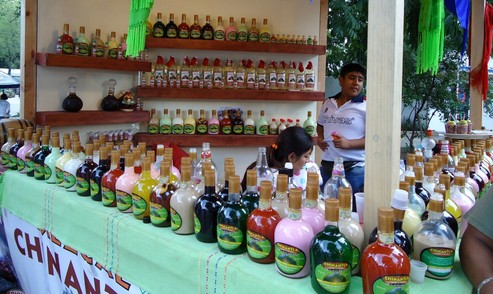
If it is indeed an international mezcal fair, why were there so few producers from other states represented, and why were there so many cremas (sweet liquors made with or without cream, milk or another whitening agent) being offered for sale, which are not even considered mezcals despite the fact that most of them probably contain a small amount of fermented agave?  Regarding the former, economics likely played a significant role in the underrepresentation of extra-Oaxaca distilleries.  
 
One friend asked if I had been to the feria de cremas yet.  I waited until the second to last day to attend, and then better understood the sarcastic nature of his question.  Upon arrival, a member of the feria staff told me that 60% of those who entered the fair were female (men and women entered through different gates, thereby enabling organizers to keep tabs).  It has always been assumed
that women more so than men are drawn towards cremas, and so from a sales and marketing perspective it perhaps makes sense to have an overrepresentation of cremas available for sampling and sale.  However cremas are not mezcals, plain and simple.  Some don’t even use the word mezcal in their branding.  If COMERCAM is policing a mezcal fair, should it not ensure that only
mezcals are being promoted?  Of course not, since that is not its mandate. The organizers perhaps? 
 
While as indicated above, there were in fact more vendors than in previous years selling mezcals made with other varieties of agave than espadín and tobalá, and the reposados and añejos were represented adequately.  On the other hand, some of the crema vendors were selling cremas and a reposado, and nothing more, not even a blanco. And at least one vendor excitedly awaiting certification of a mezcal made with agave tepeztate could only clandestinely offer samples to those he knew and trusted, for fear of pouncing narcs. 
 
The behind-the-scene politics of the Feria del Mezcal in Oaxaca is beyond my knowledge, I need not be privy to same, and perhaps best if it remains that way.  However, it is suggested that an independent overseer is required, someone who is capable of negotiating with producers, regulators and interested third parties, with a view to coming up with a solution to issues which appear to be festering and now maiming the fair’s reputation.  The ultimate goal should be to attract mezcal aficionados, both domestic and international, who do not have the time to spend days, if not weeks, seeking out and sampling quality mezcals, certified or not.  If cremas are deemed to have their legitimate place in an international mezcal fair, then perhaps charge an additional 10 pesos for admission to a special Salón de las Cremas. 

Surely artisans wishing entry can be convinced to develop a line of products relating to the subject matter of the fair.  Such a display would surely enhance the festival’s reputation. Cheese, salsa and other purveyors of foodstuffs should be interested in attracting business by holding daily open
seminars with sampling, combining each of their products with a different preferred mezcal.
 
Otherwise, subsequent festivals will continue to be mezcal fairs in name only, and the cirque du mezcal will live on and leave in its wake what could have become a world class celebration of mezcal and agave.  
 
Alvin Starkman has been an aficionado of mezcal for two decades.  He operates Casa Machaya Oaxaca Bed & Breakfast with his wife (http://www.casamachaya.com), Oaxaca Culinary Tours with Chef Pilar Cabrera (http://www.oaxacaculinarytours.com), and helps visitors to Oaxaca to learn
about mezcal, pulque and other Oaxaca beverages and foodstuffs. 


Temazcal in Oaxaca, Mexico, Instills Community Sense

07/22/2013

 
Picture
Alvin Starkman, M.A., J.D.

Before the arrival of the Spanish, the temazcal was a village sacrament for the indigenous people of Mexico.  It involved cleansing body and mind with curative plants, heat and vapor. But it was the ritualistic aspect of the activity, with the uniting of tens of community members at a time, which likely led to the conquistadores outlawing the practice. Even if religion was not specifically expounded in storytelling, chanting and prayer, the mere acknowledgement of the power of nature was surely enough to create unease in the minds of those early, very Catholic invaders.
                                 
-------------------------------------------------                         
­­­­­­­­­­­­­­­­­­­­
In the village of San Juan Guelavía, a short drive from the southern Mexico city of Oaxaca, Maestro Albino Melchor Cruz explains that while the Spaniards were concerned with permitting the practice of
the temazcal to continue as a traditional gathering of many, they were much less apprehensive about its persistence on a smaller scale; perhaps an adobe hut into which a couple, or a shaman and an infirmed pueblo member entered.  This would have been much less threatening to the order they wished to establish and affirm.  Thus the more intimate manifestation of the temazcal was allowed to persist, likely unchecked. 
 
In modern-day Oaxaca the small, ceremonial temazcal appears to be more the norm.  But according to Don Albino, there is no right or wrong way to either perform, or experience it.  While he and his disciple / assistant Carmelita and her daughter Karina carefully bind together branches of select herbs, he explains that “no two temazcales are the same, and it´s not appropriate to just go out and copy what someone else has created.” 

Don Albino’s igloo-shaped construct holds up to forty individuals on two circular levels; seating platforms are made of red clay brick, mortar and stone. In the middle there is an earthen pit, four feet in diameter into which hot rocks are placed. Yellow marigolds encircle the pit, just above it. 
The walls are adorned with tied branches of aromatic herbs and once again marigolds, one of the two flowers customarily employed at Día de los Muertos rituals.  In the middle, hanging from the center of the domed ceiling by a hemp-like rope is another floral and herb arrangement.

But a temazcal is much more than going into a chamber and sweating while becoming revitalized through verse, steam erupting as a consequence of water having been poured over red hot rocks. 

On a Saturday afternoon in June, 2013, while my wife and I are awaiting the arrival of others who would partake in the experience along with us, Don Albino explains that the temazcal has already
begun; from the first moment we sat down and began our instruction, through our initial cleansing in the course of rubbing and swatting ourselves with an array of bound leaves, and with massage. 
                           
-----------------------------------------------------

A young, impressionable Albino began taking martial arts classes at age 17. Over time he gradually started to reflect more and more about what he was doing, and why.  He had earlier begun assisting his father, a chivero [in Oaxaca, someone who roasts meat in the traditional way – see below] by trade. He first became exposed to the concept of universal energy through his martial arts
training, and by his father via a concomitant, fire. In a highly ritualistic fashion dictated by age-old
custom
, father and son would prepare meat, most often goat or sheep, in an in-ground oven over firewood and rocks; the festive meal accompanying rite of passage celebrations.  

It was inevitable for someone like Albino, born and raised in the nearby city of Tlacolula de Matamoros, from time to time to hear about temazcal and its basic functioning. Its ritualistic and spiritual aspects were not all that foreign to him given his prior life experiences. He proceeded to seek out someone who could teach him more about it.  And so it was upwards of two decades ago that Albino encountered healer Don Álvaro, who first exposed him to temazcal. 

Over the ensuing years, under Don Álvaro’s tutelage Albino began doing research, in due course visiting the homes of shamans and others with expertise in the science and art of temazcal, in diverse parts of the country.  They eventually would become colleagues of Don Albino, travelling to his facility in San Juan Guelavía, maintaining a healthy interchange of ideas and techniques.
                            
------------------------------------------------------

“When you’re attending alone for a temazcal, it’s total introspection, as if you’re looking into a mirror.  If you’re with another, there’s that intimacy as you would share with your partner.  And if with two others there is the sense of being with guardians, your parents if you will. Finally, when there are more, as in a group, it represents and provides the feeling of community, as you’ll experience today.”
 
As Carmelita begins to tell her story in the presence of her daughter, my wife and I, and two of our friends, Don Albino’s words start to ring true.  Perhaps it’s because we had all been given basil flower and leaf and asked to rub it all over our clothed bodies, then close our eyes and reflect, and finally express our thoughts to the others.  But it’s more likely as a result of empathizing with Carmelita’s earlier struggles, as she acknowledged, with headaches lasting from a week to a month, an unhappy first marriage, her feeling of incompetence in her ability to raise her family.  Temazcal had become her salvation.

This may have been a unique experience which will never be repeated, but it was nevertheless indicative of what can happen in a group environment, defenses slowly falling by the wayside with each step of the process; recognizing the nakedness, the primordial truth in simple words. Carmelita explains:

“The temazcal, beginning here and now,
and concluding after we leave that dark, steamy, herb-infused chamber, is not a
new consciousness, but rather something we all have, that is awakened; a love of
oneself – and you can’t love another until you love
yourself.”

The others arrive; a family recently relocated to the state of Oaxaca from Nayarit.  Don Albino gives each of us a selection of branches of curative plants tied together, and asks us to whack ourselves
with the bouquet, directing us to each part of our bodies; head, shoulders, knees, toes, and everywhere in between, back, front and middle. “Harder, much harder, you can do it,” he advises. He next places a sprig of yet another herb in our hair, then from behind massages our heads, then gives a brief shoulder massage followed by lifting us up by embracing tightly below the chest
area.  He instructs us how to breathe.  

We are each given a cup of citrus tea, made with the herb cedrón.  He then takes a Lord of the Fliesian conch and blows it several times, once as he stands behind each of us. Finally, he massages each of us for a minute or so while we lie on our stomachs. Disciple Carmelita massages Don Albino. 
                                    
-----------------------------------------------

The temazcal chamber is in close proximity to a circular enclosure where firewood has been heating up rocks for the past couple of hours. The campfire smell had been pervading our preliminary activities and the tail end of our discussion, so when we were finally asked to walk over to the chamber, what we encountered came as no surprise.

“You can wear whatever you want into the temazcal,” Don Albino reassures, “just as you are if you like, but yes, it will be hot and steamy, so if you have a towel or sheet, or a bathing suit, it would
be more comfortable for you.”

This is the real deal, I quickly conclude shortly after entering the dark room; a combination of chanting, rattling of gourds containing corn kernels, steam, waves of herbal aroma, all over the
course of at least an hour-and-a-half. And the ceremonial nature of it all, with detailed explanation by Don Albino grounded in both science on the one hand, and lore mixed with convincing conjecture on the other.  
 
While there may be little in the way of documentary evidence of the ceremonial use of temazcal, academics have nevertheless written extensively about its use, including its curative powers and the assistance it afforded mother and newborn around childbirth. The archaeological record cites the discovery of codices, figurines and remnants of pre-Hispanic temazcales, together confirming its importance. Don Albino in fact notes its ritual significance while discussing the archaeological sites of Monte Albán, Yagul, San José el Mogote and Mitla.

I had experienced the other end of the temazcal continuum several years earlier, in a small, much more enclosed setting.  While I found it relaxing and enjoyable, and in fact sensual given the intimacy of the environment, there was a pervading subtext of hokey and contrived, duly noted by me.  Here, by contrast, there was no mumble jumble I could not understand. No catholic rhetoric. Of course not, if indeed we are truly partaking in an experience with origins predating the Christian era. 

Don Albino emphasized community context of the temazcal, and thus its broad importance became abundantly clear as the day progressed. I felt that I was understanding what was behind it all, and hence learning with a greater sense of historical and in fact personal appreciation.

With Don Albino discussion includes but runs much deeper than a mere mention of the elements of fire, water, earth and wind.  He had earlier noted four doors, but I didn’t completely understand their significance until we were all inside the chamber and participating in the ritual.  
                                  
-----------------------------------------------

There is a small window at one end, and a doorway at the other. A blanket covers the entrance until Don Albino summons his son to begin.  A pitch fork with a hot rock is ceremoniously passed by son through the doorway, to father who gingerly places it in the pit.  The process is repeated three times.  Then a bucket filled with water and a bouquet of aromatic plants.  Darkness prevails.  Don Albino shakes the water-drenched spray over the rocks.  Steam rises.  The heat increases as vapor permeates the room with each dousing.  Don Albino cranks it up a notch by swinging the flowers and herb branches dangling from the center of the ceiling, back and forth and around. 
 
This is the first door, the east, fire, representing birth and song, the singing of birds.  We are welcomed to join in the chants.  Two participants are shaking the rattles.  Then more water. Waves of herbal fragrance ebb and flow.  For two of the next three doors, again rocks are brought in and placed in the pit, steam rising and encircling. And twice mezcal is passed around, each of us pouring a small cup for our neighbor. It’s then poured onto the rocks, changing the scent to the distinctive sweet and smokey smell of distilled agave.

The second door represents water and the sea, the south, transforming suffering to happiness. Carmelita expresses her thoughts as she had done earlier, her struggles.  The rest of us are welcomed to give thanks to whomever, for whatever, more or less obligatory; at least I feel
somewhat compelled to say something. For the rest it perhaps comes easier.

The third door, the west, is wisdom, learned from our ancestors and carried forward through birth of generations. It corresponds with earth.  And finally the north, from which the wind blows, providing a time for stillness.  

Throughout this phase of the experience Don Albino once again massages our heads and shoulders and blows the conch, walking behind each of us as he does so.  There is no talk of the father, the son or the holy spirit, but rather god in the most general, spiritual sense.  The Maestro also teaches a little science as well, instructing us about the impact of being in the steamy, fragrant temazcal, on our blood and on vital organs such as lungs and kidneys. There is time for reflection.  He again encourages deep breathing. 

Don Albino suggests that the experience is coming to an end.  Most of us slowly descend to our hands and knees as we leave the chamber, head first. “Notice,” Don Albino conveys, “how you’re leaving the temazcal, headfirst crouched down, as if emerging from the womb to a new life.”

In a sense it did seem somewhat like birth I suppose, or rather a rebirth; at least to the extent of having made new acquaintances with a special bond between us, a sense of community with the
group members.  Will it last?  Something will definitively endure. 
 
Don Albino provides temazcal experiences to individuals, couples,
families, and groups of up to 40:

TEMAZCAL TRADICIONAL PORTAL DEL SOL,
KM 25.5 CARRETERA OAXACA-MITLA,
CRUCERO DE SAN JUAN GUELAVÍA
(951) 562-0492; CEL 0449511965173
ALBINO MELCHOR CRUZ, TERAPEUTA
 
Alvin Starkman has written over 280 articles about life and cultural traditions in the central valleys of Oaxaca.  He and his wife run Casa Machaya Oaxaca Bed& Breakfast.  Alvin assists travelers visiting Oaxaca to plan their vacations, and often takes tourists to the nearby sights including markets, ruins, craft villages and quaint mezcal distilleries.  He operates www.oaxaca-mezcal.com. 


Picture
 

Gifting in Oaxaca: Advice for Academics, Tourists & Recent Expatriots

05/29/2013

 
Picture
Aside from what to wear, it’s the most common conundrum faced by tourists visiting Oaxaca, and even those ex-pats who have recently moved to this colonial city in Southern Mexico:  what to give as a gift when invited to a wedding, quince años, baptism, anniversary party, or any other event marking a joyous rite of passage. 

On the other hand, being invited to a regular  social gathering without a specific purpose or motive is distinctly different, and a much easier problem to resolve, since such get-togethers can be viewed as they are in the US or Canada; regardless of the socio – economic status of the host, you can bring a box of chocolates, flowers, tequila or wine (the latter more for the middle classes), something for the household, or even a souvenir representative of your home country such as a bottle of maple syrup.  

Celebrations of Rites of Passage in Oaxaca

Oaxacans celebrate rites of passage much more frequently and with much more gusto than Americans and Canadians.  In some cases, even for non-significant birthdays (i.e. the ones we traditionally allow to pass without special acknowledgement) there is an expectation that your friends and relatives will drop over for a comida or cena, even if no formal invitation has been extended. Thus, Oaxacans are continually being inundated with social obligations. 

And given that in Mexico, family extends to compadres as well as blood relatives, family gatherings to acknowledge a plethora of rites of passage can at times take place almost weekly because of “fictive kinship” relationships.  The implication is that in Oaxacan society there is much more gift giving than in the US or Canada; meaning that economic constraints dictate, in general, a more modest gift giving regimen.   On the other hand, there is an adage which goes something like this:  the reason that most Oaxacans have two or more jobs is that the first one provides a salary sufficient to look after the necessities of life, and the others cover the cost of social obligations.

Who Gave Us the Green Blender?

It’s still normative behavior in many towns and villages, and amongst working or lower class urban Oaxacans, to not enclose a card with a gift, though of course one can certainly do so.  This suggests that anonymity is accepted in terms of the gift you give.  Thus, you can “get away with” something more modest than one would otherwise reason.  Often there is a reception line wherein you’re expected to physically present your gift.  If it’s wrapped in a gift bag or box, the recipient must have a pretty good memory to recall that it was you who gave the medium sized box wrapped in blue paper with a purple bow.

On the other hand it is still common practice to present a gift affixed to a piece of stiff and smartly decorated board and shrink wrapped in clear plastic.  Thus it’s much easier for the recipient to recall who gave the green blender.  It’s a bit more confusing when there are four or five blenders gifted at a wedding, a common scenario.

Urban Gifting in Oaxaca

Registering for wedding gifts is becoming more commonplace in Oaxaca than it was even ten years ago.  Registering with a department store with branches throughout the country such as Sears and Liverpool (Fábricas de Francia) is becoming particularly in vogue for couples who will be setting up a household outside of Oaxaca. Since almost all culturally middle class Oaxacans send their children out of state for university, there is an increased likelihood that couples from two different states will marry.  And they’ll locate in the state of the spouse who is not from Oaxaca, for economic reasons; it’s harder to make a living in Oaxaca than in most other states.

Similarly, it’s becoming more acceptable to request cash as a wedding gift, making the decision easier except for deciding upon the amount.  Thankfully the middle and upper classes now understand that not all foreigners are multi-millionaires.

Regular gifts run the gamut, in both urban and rural environments, and include items which we as foreigners would not think are appropriate, such as a lamp or a set of towels for a baptism or first communion, a pair of inexpensive earrings for a wedding anniversary, etc.

Donating to a couple’s own well-being has arrived in Oaxaca.  In a recently received invitation to a 30th wedding anniversary bash for a well-to-do couple, cash was requested; and envelopes were distributed at the door, with a pen enabling the invitee to note his name.   Appropriate?  Perhaps, given that in Oaxaca the concept of requesting donations to a particular charity has not yet arrived.

It’s Hard to Go Wrong with Benevolence, Religious and Otherwise

Anything goes regarding gift giving in Oaxaca.  There does not appear to be the same perception of receiving an inappropriate gift, or “not enough.” A gossip network does not exist.  Oaxacans don’t talk about the gifts they receive.  They virtually never send thank you notes.

If you’re really stuck, and this article doesn’t serve its intended purpose, there’s always the option of attending at a store specializing in religious gifts such as rosaries, crucifixes, bibles and retablos.  But first ensure you know that you invitation has been extended by a Catholic.  

Alvin Starkman has been gift-giving in Oaxaca for two decades.  With his wife Arlene he operates Casa Machaya Oaxaca Bed & Breakfast (http://www.casamachaya.com), and with Chef Pilar Cabrera Oaxaca Culinary Tours (http://www.oaxacaculinarytours.com). Alvin enjoys assisting tourists to Oaxaca in planning their vacations.  Alvin has been working with the federal government in various projects for the past two years (Mexico Today and the CONOCER mezcal training program).


Mezcal & Pulque: Sustainable Industries in Oaxaca, Mexico, Revisited

05/06/2013

 
Picture
This essay augments and synthesizes earlier treatises on modern day, traditional production of mezcal and pulque as green, sustainable industries in Oaxaca.  It is restricted to sustainability as it correlates with direct by-products of small-scale commercial mezcal and pulque production.  It is beyond the scope of this endeavor, accordingly, to even touch upon the historical utilization of agave, or its current uses unrelated to making fermented beverages and mezcal.  It remains a work in progress and is by no means meant to be the definitive or a complete statement on the theme. Finally, the reader should be aware that it does presuppose a basic knowledge of traditional production of mezcal and pulque in Oaxaca.

Growth of the Maguey

Whether Agave angustifolia (espadín, still the most common variety of the plant cultivated for making mezcal), or Agave americana (generically referred to as pulqueros, the varieties used to ferment pulque), these magueyes as they’re locally known, thrive in desolate landscapes, where soil fertility is frequently low and rain is often restricted to a single season. They grow on both steep mountainside slopes and in fields.  Naturally the length of time to maturity as well as size and quality of the plant are affected by climatic and other conditions; but the plant does well everywhere within a certain range of elevations in southern Mexico.

Baby agaves harvested from quiotes (stalks) are best planted in beds and watered once or twice a week during dry season.  Then, after transplanting into permanent fields during rainy season, they require no irrigation through maturity, which usually occurs six to eight years hence.  Fertilizer is not required.  Ongoing care and tending is often non-existent, though periodic checking for infestations and weeding is practiced by many growers. Essentially, what the earth offers and the sky delivers are sufficient for producing agave prime for producing both mezcal and pulque.

Quiote, Leaves and Piña Left in the Fields

The quiote, while still green, can be milled and mixed with corn masa to make tortillas, yielding a foodstuff with a little more sweetness than the traditional staple.  When dried, the quiote is used as a fuel, to heat clay brick ovens for making comales as well as other utilitarian pottery pieces in addition to decorative figures.  The dried stalk is also utilized as a fuel for heating comales, grilling meats, boiling water, and a plethora of other uses. It has been used as a construction material, for making “log cabins,” and when covered with a layer of cement can last up to 100 years. 

The hollowed out quiote of a number of agave varieties can be used as a musical instrument.  The live entertainment which formed part of the presentation earlier this year of the first bilingual edition of Ulises Torrentera’s book, Mezcalaria, Cultura del Mezcal, consisted of a musician playing a series of different trompetas, as they’re known. The sound and form of playing was reminiscent of the Swiss mountain man playing the alpine horn (alphorn, a type of labrophone, bored from softwood) in the old Ricola cough drop commercial. The sound is more agreeable as part of a mixed instrument performance.  Nevertheless, the performance exemplified yet a further example of the versatility of the quiote.

The thick, broad leaves of Agave americana, but more commonly the succulent protrusions of angustifolia, are encountered bundled and drying on the rooftops of village homes in agave growing country, particularly in areas where production of pottery is a cottage or more commercial industry.  As with the quiote, the leaves are employed as a fuel, sometimes as simply a fire starter, but regularly as a primary “firewood” if you will, for fueling pottery ovens, heating comales, grills and clay pots, and for preparing traditional Oaxacan beverages found in marketplaces throughout the state such as chilacayota, and more often tejate, the corn and cacao based highly nutritional drink of pre-Hispanic origins.

In the production of pulque, at the initial phase of preparing to carve out a well in the heart of the agave for the extraction of aguamiel, leaves are removed.  And over the course of ensuing weeks and months as the plant is being tapped twice daily, additional leaves are excised from the living and indeed still green agave. These fresh leaves are almost always used to add flavor to traditional barbacoa, the goat, sheep or beef prepared in an in-ground oven. After each extraction of aguamiel, a layer of flesh from inside the well is scraped away in order to help the plant to “bleed” once more. The scrapings are often used as chicken feed.

When the pulquero has run its course and is no longer viable for producing aguamiel, the heart or piña can be baked along with other unadulterated piñas, to make mezcal.  But generally speaking the remaining nutritional value of the piña is so low dictating that it’s not worth the time and effort to further use the plant for mezcal production.  On the other hand, with all the leaves completely removed from the agave, and a mere hollow shell remaining, if dried this conical piece of heavy hollow plant product is can be converted into a bongo drum by affixing pieces of tanned hide to each end.  Together with the trumpeta we now have half of the prerequisites for a quartet. 

Sustainable Mezcal Production I:  Baking the Agave

Many palenqueros in Oaxaca use whatever logs are readily available to bake agave, with their purchase motivated mainly by price.  However, those who produce the spirit for more commercial and export consumption (as opposed to for a more local population) for a number of reasons are more particular in selecting the type of wood they burn.  However, seconds in the forestry industry which are not prime for construction are generally preferred because of the reduced price.  This adds to the sustainable nature of mezcal production.

The typical oven is merely a pit dug into the ground, at times lined with clay brick or stone depending on the substratum.  The rocks placed on top of the smoldering wood are obtained from small, nearby quarries.  A layer of wet fiber, discard from the distillation process, insulates the agave piñas from the hot rocks, thereby inhibiting charring of the bottommost agaves, that is those closest to the rocks.  Empty, used grain sacks are ritualistically employed to then cover the mound of agave.  The final layer is simply earth. An airtight oven is thus created, at times with logs placed on top of the oven to ensure the earth stays in place.

Once the baking is complete and the piñas and rocks have been removed from the oven, charcoal rather than ash remains in the very bottom of the pit.  The charcoal is sold, or used by the palenquero and his family as a fuel for cooking. The charcoal imparts different flavors in grilled meats, not only based on the type of wood from which it has been derived, but from the sweet, caramel-like baked agave.

Sustainable Mezcal Production II:  Crushing and Fermenting

The two main methods of crushing baked agave are:  (1) employing workers from the local community who use heavy wooden mallets to pulverize the pieces of piña which have been placed in a stone or wood lined “canoe” in the ground; (2) having an employee work a beast of burden to crush the agave after it has been chopped into pieces with a machete and placed in a stone-lined shallow circular pit – the horse, donkey or mule drags a limestone wheel over the agave.  In either case, local labor is employed, more so than when more industrialized methods employing diesel or propane fuel and modern stainless steel and related equipment rather than animal or human labor. 

Towards the end of fermentation, a thick gooey layer forms on top of the fermentation vat.  The substance is used as a sealer during distillation.  Whether a copper, or a clay pot and carriso (river reed) still is used, two chambers are sealed with this substance once the lower chamber has been filled with the fermented liquid and fiber.  

Sustainable Mezcal Production III:  Distilling

Since the wood used to fuel traditional Oaxacan stills (alambiques) of either type does not come in direct contact with the fermented agave fiber and juices, the type of firewood purchased is of less significance than the wood used in baking, the latter selected for its specific properties.

The water used for cooling and condensing is the same water used to clean out the clay or copper pot after the first distillation. It can also be used to irrigate. Accordingly, the same water can be used for three purposes. Finally, the liquid in the alambique remaining at the end of the distillation process, can also be reused to irrigate.

Perhaps the most valuable by-product of the entire process, and which has the greatest number of secondary uses, is the fiber remaining in the still at the conclusion of the first distillation:

·       as noted earlier it is used as an insulator between the hot rocks and agave piñas during the baking process;

·       it can immediately be used as mulch;

·       it can be used as compost after having been left to break down for between six months and two years;

·       it can be used as feed for certain farm animals;

·       it can be used as a fire starter, a kindling of sorts;

·       it can be used as a substratum in commercial mushroom production;

·       it can be used to make adobe bricks when mixed with mud and sand.

Epilogue

The stalk, the leaves, the piña; the pit, the wood, the labor; the water and the fiber.  Virtually every constituent in each stage of the traditional process of making both mezcal and pulque in Oaxaca is characterized by sustainability.   Recylcing and reusing for economic reasons, out of a concern for the environment or simply convenience. It really doesn’t matter.  The secondary uses of the materials and means of green production in these two agave-based sustainable Oaxacan industries are remarkable.

Alvin Starkman resides in Oaxaca.  He has been a mezcal and pulque aficionado for two decades, helping likeminded visitors to the region and those interested in export or learning more, to get out into the fields and to the various types of palenques to sample, buy and understand more about Mexican fermented and distilled drinks. He co-owns Casa Machaya Oaxaca Bed & Breakfast (http://www.casamachaya.com) and Oaxaca Culinary Tours (http://www.oaxacaculinarytours.com), and uploads interesting information about mezcal and pulque to http://www.oaxaca-mezcal.com. 


Casa de la Mujer Charity in Oaxaca Benefiting Women

04/29/2013

 
Picture
Casa de la Mujer:  Benefiting Indigenous Oaxacan Women for 35 Years

Alvin Starkman, M.A., J.D.

Casa de la Mujer is arguably the most important resource available to young, bright indigenous women who would otherwise not realize their full potential as contributing members of Oaxacan society.  The charity’s reach extends throughout all eight regions of the state.  Its mission is to contribute to the transformation of a more just and equitable society respecting women’s rights.   

The umbrella organization is comprised of three intertwined programs:  Grupo de Estudios sobre la Mujer “Rosario Castellanos” which was founded in 1977; a research and development arm known as Investigación-Acción; and a scholarship fund known as el Fondo Guadalupe Musalem A.C., formed in 1995, and for more than 15 years boasting internationally renowned singer-songwriter Lila Downs as its most prominent supporter and promoter.   

Every April Casa de la Mujer announces in rural communities throughout the state of Oaxaca the availability of scholarships to assist students in obtaining their high school education.  The prerequisites for acceptance into the program are: 

·        Being a woman less than 20 years of age who is native to Oaxaca, and of either indigenous or African descent

·        Successful completion of junior high school with an average GPA of 9

·        Having the desire and willingness to work with women in their community

·        Making a commitment towards solidarity with the tenets of Casa de la Mujer

·        Periodically complying with requirements established by the scholarship fund

Those accepted into the scholarship program receive 2,000 pesos per month for each term of 12 months, during which they are required to attend high school either in their communities, or close to their homes in cases where higher education is not available in a particular village.  In many cases the transportation alone required to enable a student to attend high school in a distant town is great enough to dissuade parents from encouraging their children have their sights set on high school.  Thus, many bright students have little if any incentive to even complete junior high.

The monthly stipend is intended to cover the cost of books and related educational supplies, inscription fees each semester, food and clothing, transportation and housing costs in cases where students must travel outside of their communities to attend school, and other sundry expenses.  Each month students must enumerate in writing expenses incurred, with balances carried forward to subsequent months, thus ensuring accountability.   Provision of medical, dental and psychological services are included as one of the scholarship benefits, generally provided by professionals practicing in close proximity to the Casa de la Mujer premises in downtown Oaxaca.  Each scholarship recipient is periodically assessed by a Casa de la Mujer staff member, an advisor of sorts. 

Students are encouraged to attend monthly weekend workshops in Oaxaca.  In many cases they spend six hours or longer on public buses on Friday getting them to Oaxaca, and again on Sunday returning them to their home villages.  Areas covered in the seminars include personal, social and cognitive development; artistic expression; and tools for working within the community.  Plenary sessions include strategies for dealing with insecurities; self-esteem and assertiveness training; life planning; women’s rights; and dealing with violence in the community.  The curriculum includes working in groups while focusing on theatrical expression.

Since the inception of the Casa de la Mujer scholarship fund, close to 100 young women have participated in the program, benefiting 58 indigenous and rural communities representing all regions of the state, including the coast.  Twenty-six alumni have gone on to university, and 16 have graduated, in fields as diverse as chemical engineering, psychology, law, history and anthropology, mathematics, biology and architecture. Some have received national recognition for their achievements, and others have been awarded scholarships to study in universities in the United States.  

Donations to the fund are deductible from US income, and it’s anticipated that in the near future the same will hold true for Canadians.  You can donate as little as 100 pesos per month to the fund.  At last count there were 190 individual and corporate sponsors donating over one million pesos annually.   For those wanting a more direct involvement in the success of a bright indigenous Oaxacan woman, arrangements can be made to donate 2,000 pesos per month to cover all of the expenses of a particular student. 

In addition to the foregoing revenue generated for Casa de la Mujer, every year Lila Downs, husband and musical director Paul Cohen, and the rest of their band, hold a benefit concert in Oaxaca.  Last year’s performance raised over 122,000 pesos.  During the concert Lila calls all of the current scholarship recipients to the stage, at which time they are congratulated –  with the strongest heartfelt and emotional applause imaginable.  Sometimes alumni who have gone on to establish careers are given special recognition.

Imagine the feeling of being at a Lila Downs concert, and seeing this group of young women on stage, proudly clad in their traditional regional dress, knowing that you have played a part in their personal, social, emotional and educational development.

To inquire about donating to Casa de la Mujer, email [email protected] or call (951) 516-6810 (http://www.gesmujer.org). You can also email me at [email protected].

Alvin Starkman operates Casa Machaya Oaxaca Bed & Breakfast (http://www.casamachaya.com) with his wife Arlene, and Oaxaca Culinary Tours (http://www.oaxacaculinarytours.com) with Chef Pilar Cabrera.  Alvin frequently assists tourists in planning their visits to Oaxaca and the sights in its   central valleys. He is a director of the Canadian charity, CANFRO (Canadian Friends of Oaxaca Inc.)


Mezcalaria, The Cult of Mezcal: Book Review

04/16/2013

 
Picture
Alvin Starkman, M.A., J.D.

Mezcalaria, Cultura del Mezcal, The Cult of Mezcal (Farolito ediciones, 2012) is the third edition, first bilingual (English-Spanish), of the seminal 2000 publication by author Ulises Torrentera.  The book is highly opinionated on the one hand, yet on the other contains a wealth of both historical and contemporary facts about agave, mezcal and pulque.  Torrentera places his subject matter within appropriate social, cultural, ethnobotanical and etymological context, at times referencing other Mexican as well as Old World spirits and fermented drinks.  And where fact is uncertain, or when Torrentera feels the need to supplement in order to hold the reader’s interest, he infuses with myth and legend. 

Torrentera takes the reader far beyond the decades old introductory book, de Barrios’ A Guide to Tequila, Mezcal and Pulque and much deeper into the field of inquiry than the more recent series of bilingual essays in Mezcal, Arte Traditional, although the latter does include excellent color plates (the Spanish first edition of Mezcalaria contains a few color plates). It stands at the other end of the spectrum from the monolingual coffee table book Mezcal, Nuestra Esencia and is far more comprehensive than the English portion of Oaxaca, Tierra de Maguey y Mezcal.

Torrentera’s passion for mezcal rings loud and clear.  In discussions with him and in the course of hearing him hold court, he has repeatedly indicated that it’s crucial that more aficionados of alcoholic beverages taste and appreciate all that mezcal has to offer.   That’s his motivation for writing, speaking, and exposing the public to mezcal in his Oaxaca mezcaleria, In Situ. The spirit, paraphrasing his viewpoint, leaves its main rival tequila behind in its wake, primarily because of the numerous varieties of agave which can be transformed into mezcal, the broad range of growing regions and corresponding micro-climates, and the diversity of production methods currently employed,  the totality yielding a plethora of flavor nuances which tequila cannot match.

His treatise, on the other hand, to some extent does his raison d´être a disservice. He is overly critical of mezcal that is not to his liking.  For example, in the Prologue to this first English edition (don’t let the poor and at time incomprehensible translation of the Prologue dissuade an otherwise prospective purchaser; the balance of the book is well translated) Torrentera writes of mezcal with more than or less than 45 – 50% alcohol by volume:  “above that graduation [sic] the flavors of mezcal are lost and there is more intoxication; if it is below this one cannot appreciate the organoleptic qualities of the beverage.”  He also writes that unaged or blanco is the best way to appreciate mezcal.  He continues that in his estimation “cocktails are the fanciest manner to degrade mezcal.”

Indeed, I regularly drink one particular mezcal at 63%, which is exquisite, and numerous other mezcales in the 52% - 55% range which my drinking partners and I enjoy; we appreciate flavor nuances without becoming overly intoxicated.  At the other end of the spectrum, a recent entry into the commercial mezcal market, produced in Matatlán, Oaxaca, is 37%.  The owners of the brand held well over 50 blind taste testings in Mexico City, including mezcales of less percentage alcohol, of greater potency, and of popular high end designer labels; 37% won out by a wide margin.  In the first year of production it shipped 16,000 bottles of 37% alcohol by volume to the domestic market only; not bad for a mezcal lacking organoleptic qualities.

Regarding the blanco/reposado/añejo issue, why not encourage novices to try it all and decide for themselves?  Why dissuade drinkers of Lagavulin, or better yet Glenmorange sherry or burgundy cask scotch from experimenting with mezcal aged in barrels from French wine or Kentucky bourbon?  While I appreciate Torrentera’s zeal and his belief, his dogmatism may very well serve to restrict sales of mezcal and inhibit valiant efforts to find convertees.  Many spirits aficionados might prefer a mezcal which he does not recommend.  Furthermore, if mixologists and creative bartenders can increase sales and market mezcal through mixing mezcal cocktails, isn’t that what the Maestro wants?

Torrentera’s reflections are otherwise sound and should find broad agreement with readers, be they mezcal or tequila aficionados or novices, or those who are otherwise followers of the industry.  I’ve often expressed his point that far too many exporters and large scale producers are padding their bank accounts at the expense of campesino growers and owners of small distilleries, the mom and pop “palenques” as they’re termed in the state of Oaxaca.  He laments the regulatory direction mezcal appears to be heading, and pleads for change in the NOM (Norma Oficial Mexicana) and for a better and more discerning and detailed system of classification.  He warns of mezcal heading in the direction of tequila in terms of homogenization.

Torrentera’s work is the most comprehensive and detailed endeavor available in English, which combines and synthesizes literature about agave (historical uses and cultural importance), pulque (within global context of fermented beverages) and mezcal (as one of a number of early distilled drinks). He appropriately criticizes, mainly in the Prologue, academic studies which have provisionally concluded, using a bastardized form of scientific method, the existence of distillation in pre-Hispanic times.

The author shines in his compiling, extensively drawing from, and quoting diverse bodies of work; scholarly, historical anecdotal, as well as both secular and religious Conquest era laws and decrees.  His bibliography is impressive.  He correctly cites inconsistencies in and difficulties interpreting some of the centuries old references, allowing the reader to reach his own conclusions.  If a criticism must be proffered, occasionally it is difficult to discern when he is quoting versus using his own words.  But this is likely an issue with editing and printing than fault of Torrentera. At times he does neglect to indicate dates and sources, making it hard to determine precisely how much is independent research.  Footnotes would have helped in this regard, and also would have made it easier for the reader to go to the original source material.

Torrentera vacillates between seemingly attempting to write in an academic manner, and inserting intra-chapter headings and content which would appear to be attempts at humor.  To his credit, however, the difference is easily discernible, and accordingly the reader should have no difficulty distinguishing fact from lightheartedness.

Mezcalaria, Cultura del Mezcal, The Cult of Mezcal, is an important and extremely comprehensive body of work.  It should be read by everyone with an interest in agave, mezcal (or tequila) and / or pulque.  Torrentera is to be congratulated for compiling what no other writer to date has been able to do.

Alvin Starkman has been an aficionado of mezcal and pulque for 20 years.  A resident of Oaxaca, Alvin frequently takes visitors to the state into the outlying regions of the central valleys to teach them about mezcal, including different production methods, flavor nuances and the use of diverse agaves.  Alvin has written extensively about mezcal and pulque and has recently begun compiling a body of literature:   http://www.oaxaca-mezcal.com.  He can be reached at [email protected].

 

Oaxaca Mezcal Producers Court Sociedad de Mezcaleros on Central Valleys Visit

04/04/2013

 
Picture
Palenqueros near San Baltazar Chichicapam, Oaxaca

Over the past two years, mezcal’s star has reached new heights with each passing month. The incidence of its Oaxaca producers and exporters, acting upon knowledge of the pending arrival onto their turf of American and Canadian mezcal aficionados and connoisseurs, has been nothing short of remarkable, at times droll.

Bartenders, Bar Owners Included in Sociedad de Mezcaleros Tour of Oaxaca

In March, 2013, the secretive Sociedad de Mezcaleros embarked upon a major sojourn into the heart of Mexico’s agave producing country, a region so climatically suited to the growing of maguey, that some of Jalisco’s tequila producers have stepped up their pirating ways in trucking off multi-ton trailer loads of Oaxacan piñas.

The first wave of mezcal aficionados to arrive for the tour was an entourage of bartenders and bar owners, closely followed by architects, journalists, photographers, and those whose mere curiosity about the Sociedad had been too hard to resist. Almost all of the  Sociedad members had hailed from the American northwest, an area of the U.S. which, judging from the interest generated in the community of mezcal producers and their marketing arms, will soon overtake New York City as the country’s spirits and cocktails trendsetter.  In fact, La Carta de Oaxaca and Mezcalería Oaxaca, both based in Seattle, have been at forefront, doing more than their fair share.

Oaxaca Mezcaleros Come a Courting

No less than six stakeholders, part-owners of an up-and-coming brand of the beverage, swooped down on Oaxaca, coming from their homes and offices in diverse corners of both Mexico and the U.S., to converge upon their new found land of gold, to meet, greet and court.  Now to be fair, a specific date had earlier been set for a visit to their palenque.  But they otherwise spared no late night energy in tracking down the spirits aficionados and imbibing with them, each to his fullest capacity.  Whatever food and watering hole the Sociedad recommended to its flock, the mezcaleros were sure to follow.

                                               ------------------------------

A recent trend in not only Oaxaca, but also in other Mexican states, has been the emergence of young attractive women on the mezcal scene.  Some are distillery employees hired to market, promote and ultimately sell.  Others, and not to take away from their sometimes involvement in day-to-day distillery operations, are front (wo)men,  members of families which have either been palenqeros, or have  invested in the purchase of an existing mezcal operation.  Using sex to sell alcohol is not the exclusive right of breweries.

Now once the group had had an opportunity to personally meet Mademoiselle X at her family’s palenque, it didn’t take long for them to begin texting her, advising of their whereabouts for the duration of their visit, and suggesting a further rendezvous or two – notwithstanding that at least for this tour member it quickly became obvious that Mademoiselle X was not the one to consult with questions of a technical nature relating to mezcal, its production and its sale.  To her credit she readily acknowledged that she was a novice, with a lot to learn.  But the señorita tan güapa was up to the task at hand, and she both fit and fulfilled her job description to a tee.

                                               ------------------------------

Señor Y was in a different category, and while wooing was no doubt part of the game plan, he played his cards well, coming across as and indeed being more of an educator and genuine host than a wolf pouncing on easy prey.  He, as was the case with our distillery conglomerate, had previously booked a date with the group.  But Señor Y managed to finesse a way to not only extend contact with the barmen and the rest, but also set up a meeting with Mr. Journalist and  Master photographer / videographer, a brilliant and calculating move which will likely pay off in spades, much more so than how the Group of Six and Mademoiselle X approached a marketing opportunity.

More Diverse Activities of Sociedad de Mezcaleros in Oaxaca than Exposure to Exporters

The Sociedad de Mezcaleros is a living organism, continuously changing through adaptation, meeting the needs and desires of a growing and thus increasingly diverse interest group. On earlier excursions the focus was largely exploratory.  This new itinerary was not entirely void of some of those past exceptional experiences:  revisiting memorable distilleries with a view to rekindling acquaintanceships with their colorful palenqueros; relaxing at and enjoy the higher end fare of well-known downtown Oaxacan restaurants; fulfilling the yearnings for a return to favorite roadside eateries; and of course showcasing emerging adventures.

The March, 2013, tour of Oaxaca by those intrigued with the Sociedad de Mezcaleros, succeeded in delving yet further into the related worlds of agave and mezcal, both directly and indirectly, nevertheless leaving a plethora of avenues unexplored.  As Sociedad presidente cryptically concluded in his trademark fashion, “you bet we have much more in store for both neophytes and seasoned mezcalytes alike, but those details are for another discussion; and don’t forget those producers who didn’t get their hands on our group this time.”

Alvin Starkman tries to follow the every move of the secret society known as the Sociedad of Mezcaleros.  He operates Oaxaca Culinary Tours with Chef Pilar Cabrera Arroyo (http://www.oaxacaculinarytours.com) and Casa Machaya Oaxaca Bed & Breakfast with wife Arlene (http://www.oaxacadream.com).  He compiles a body of English works about mezcal and pulque (http://www.oaxaca-mezcal.com), and occasionally takes mezcal aficionados on visits to a diverse variety of distilleries, and out into the fields to harvest agave as well as aguamiel used in making pulque.  Alvin has written over 30 articles about mezcal, pulque and Mexican craft beer. Watch for his upcoming craft beer, mezcal and pulque tour of Oaxaca.

 
<< Previous

    Alvin Starkman

    blogs as a contributing writer for Mexico Today, a program for Marca País - Imagen de México

    Archives

    December 2013
    November 2013
    October 2013
    August 2013
    July 2013
    May 2013
    April 2013
    March 2013
    February 2013
    January 2013
    December 2012
    November 2012
    October 2012
    September 2012
    August 2012
    July 2012
    June 2012
    May 2012
    April 2012
    March 2012
    February 2012
    December 2011
    November 2011
    October 2011
    September 2011
    August 2011
    July 2011
    June 2011

    Categories

    All
    Alebrijes And Copal In Oaxaca
    Barro Negro
    Beer Food Pairing Mexico
    Chango Mezcalero Mezcal Oaxaca
    Chapulines Oaxaca
    Charities In Mexico Oaxaca
    Charity For Women In Oaxaca
    Church Attire In Mexico
    Cooking Classes In Oaxaca
    Craft Beer Oaxaca
    Cultural Event Oaxaca
    Day Of The Dead
    Day Of The Dead 2013
    Doña Rosa
    Driving Oaxaca Mexico
    Economy Of Oaxaca Mexico
    Ecotourism Mexico
    Education In Oaxaca
    Feria Del Mezcal
    Frida Kahlo Diego Rivera Dolls Mexico Oaxaca
    Fundación Harp Helú Health Project
    Gift Giving Oaxaca
    Guelaguetza In Oaxaca
    Healthcare In Mexico
    Hongos In Oaxaca
    Imss For Expats
    Inapam
    Ixtle Agave & Sustainability
    Magic Of Mushrooms In Mexico
    Mexican Art
    Mexican Beer
    Mexican Drug Wars
    Mexico Food
    Mexico Globalization And Infrastructure
    Mezcalaria Book Review
    Mezcal Clay Pot Ollas
    Mezcal De Pechuga
    Mezcal Export
    Mezcal Exporting
    Mezcal Fair Oaxaca
    Mezcal In Mexico (Oaxaca)
    Mezcal In Michoacán
    Mezcal In South African
    Mezcal Nuances Complexity
    Mezcal Society Oaxaca
    Mezcal Sustainability
    Mezcal & Sustainability
    Mezcal Sustainability Revisited
    Mezcal Tour Oaxaca
    Mezcal Women Oaxaca
    Micro-financing In Mexico
    Morelia En Boca Michoacán
    Mushroom Hunt Cuahimoloyas
    Mushrooms Hongos Oaxaca
    Mycology In Oaxaca
    Oaxaca Isthmus Of Tehuantepec
    Oaxaca Tours
    Organic Produce Oaxaca
    Pairing Beer & Mezcal
    Pechuga Mezcal
    Photography Oaxaca
    Promexico And Mezcal
    Rabbit Hunting Mexico
    Safe To Travel To Mexico
    Shopping In Mexico
    Sustainable Industry In Mexico
    Tejate In Oaxaca
    Temazcal Oaxaca
    Tlacolula Nieve Mezcal Fair

    RSS Feed