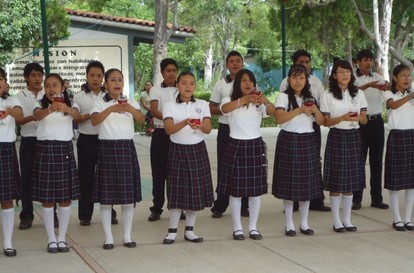
Casa de la Mujer: Benefiting Indigenous Oaxacan Women for 35 Years
Alvin Starkman, M.A., J.D.
Casa de la Mujer is arguably the most important resource available to young, bright indigenous women who would otherwise not realize their full potential as contributing members of Oaxacan society. The charity’s reach extends throughout all eight regions of the state. Its mission is to contribute to the transformation of a more just and equitable society respecting women’s rights.
The umbrella organization is comprised of three intertwined programs: Grupo de Estudios sobre la Mujer “Rosario Castellanos” which was founded in 1977; a research and development arm known as Investigación-Acción; and a scholarship fund known as el Fondo Guadalupe Musalem A.C., formed in 1995, and for more than 15 years boasting internationally renowned singer-songwriter Lila Downs as its most prominent supporter and promoter.
Every April Casa de la Mujer announces in rural communities throughout the state of Oaxaca the availability of scholarships to assist students in obtaining their high school education. The prerequisites for acceptance into the program are:
· Being a woman less than 20 years of age who is native to Oaxaca, and of either indigenous or African descent
· Successful completion of junior high school with an average GPA of 9
· Having the desire and willingness to work with women in their community
· Making a commitment towards solidarity with the tenets of Casa de la Mujer
· Periodically complying with requirements established by the scholarship fund
Those accepted into the scholarship program receive 2,000 pesos per month for each term of 12 months, during which they are required to attend high school either in their communities, or close to their homes in cases where higher education is not available in a particular village. In many cases the transportation alone required to enable a student to attend high school in a distant town is great enough to dissuade parents from encouraging their children have their sights set on high school. Thus, many bright students have little if any incentive to even complete junior high.
The monthly stipend is intended to cover the cost of books and related educational supplies, inscription fees each semester, food and clothing, transportation and housing costs in cases where students must travel outside of their communities to attend school, and other sundry expenses. Each month students must enumerate in writing expenses incurred, with balances carried forward to subsequent months, thus ensuring accountability. Provision of medical, dental and psychological services are included as one of the scholarship benefits, generally provided by professionals practicing in close proximity to the Casa de la Mujer premises in downtown Oaxaca. Each scholarship recipient is periodically assessed by a Casa de la Mujer staff member, an advisor of sorts.
Students are encouraged to attend monthly weekend workshops in Oaxaca. In many cases they spend six hours or longer on public buses on Friday getting them to Oaxaca, and again on Sunday returning them to their home villages. Areas covered in the seminars include personal, social and cognitive development; artistic expression; and tools for working within the community. Plenary sessions include strategies for dealing with insecurities; self-esteem and assertiveness training; life planning; women’s rights; and dealing with violence in the community. The curriculum includes working in groups while focusing on theatrical expression.
Since the inception of the Casa de la Mujer scholarship fund, close to 100 young women have participated in the program, benefiting 58 indigenous and rural communities representing all regions of the state, including the coast. Twenty-six alumni have gone on to university, and 16 have graduated, in fields as diverse as chemical engineering, psychology, law, history and anthropology, mathematics, biology and architecture. Some have received national recognition for their achievements, and others have been awarded scholarships to study in universities in the United States.
Donations to the fund are deductible from US income, and it’s anticipated that in the near future the same will hold true for Canadians. You can donate as little as 100 pesos per month to the fund. At last count there were 190 individual and corporate sponsors donating over one million pesos annually. For those wanting a more direct involvement in the success of a bright indigenous Oaxacan woman, arrangements can be made to donate 2,000 pesos per month to cover all of the expenses of a particular student.
In addition to the foregoing revenue generated for Casa de la Mujer, every year Lila Downs, husband and musical director Paul Cohen, and the rest of their band, hold a benefit concert in Oaxaca. Last year’s performance raised over 122,000 pesos. During the concert Lila calls all of the current scholarship recipients to the stage, at which time they are congratulated – with the strongest heartfelt and emotional applause imaginable. Sometimes alumni who have gone on to establish careers are given special recognition.
Imagine the feeling of being at a Lila Downs concert, and seeing this group of young women on stage, proudly clad in their traditional regional dress, knowing that you have played a part in their personal, social, emotional and educational development.
To inquire about donating to Casa de la Mujer, email [email protected] or call (951) 516-6810 (http://www.gesmujer.org). You can also email me at [email protected].
Alvin Starkman operates Casa Machaya Oaxaca Bed & Breakfast (http://www.casamachaya.com) with his wife Arlene, and Oaxaca Culinary Tours (http://www.oaxacaculinarytours.com) with Chef Pilar Cabrera. Alvin frequently assists tourists in planning their visits to Oaxaca and the sights in its central valleys. He is a director of the Canadian charity, CANFRO (Canadian Friends of Oaxaca Inc.)

 RSS Feed
