Casa Machaya Oaxaca Bed & Breakfast Mexico Apartment Hotel
  • Casa Machaya Oaxaca B & B / Apartment / Hotel
  • What Else at Casa Machaya?
  • Space for Children, Another Couple
  • No Surprises
  • Who Are We?
  • Our Guests' Comments
  • Photo Gallery of Casa Machaya Oaxaca Bed & Breakfast
  • Contact
  • Articles About Food & Drink, Crafts, Artists and Other Oaxaca Cultural Traditions
  • Mexico Today (CL) Blog Posts
  • Helpful Int'l Tourism Websites
  • Oaxaca Tourism Websites
  • Mexico Today Interesting Articles and News

Miniatures Artist from Oaxaca, Mexico:  Miguel Ángel Martínez Reyes Magnifies with Magnificence

4/29/2014

 
Picture


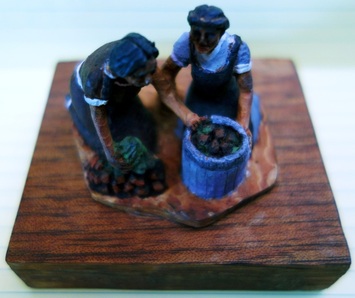
The base of this miniatures carving is about 3 cm X 3 cm, colored with cochineal (cochinilla), and made from wood of the pochote tree, depicting a typical market scene in Mexico. 

Alvin Starkman, M.A., J.D.

Despite having carved miniatures as small as 1 mm in size, the only time Oaxacan folk artist Miguel Ángel Martínez Reyes has used a magnifying glass has been when exhibiting his remarkable artwork to the public. “I have excellent eyesight, and I rarely work using artificial light; the exception being when I’m  under the gun to complete a piece with a certain deadline, which happens infrequently,” explains Martínez Reyes one morning while we’re having breakfast with his artist colleague Dolores Leycegui. “My work is so small and detailed that sometimes people would ask if I had a magnifying glass to help them better appreciate my art, so I began bringing one to my exhibitions,” he continues. 
 
The 34 year old master of the diminutive has shown his art as far away as in Treviso, Italy; as well as in Mexico City, Oaxaca and hometown city Miahuatlán de Porfirio Díaz.  The 2013 Italian museum exhibition was part of a global tribute to famed Mexican painter Frida Kahlo. He donated his creation, a carving in miniature of Kahlo and Diego Rivera made of wood from the pochote tree, to the
museum, as a gesture of his gratitude for having been invited. 

“I work with wood from the pochote tree because it’s soft, but for me bone is more elegant though more difficult and time consuming; when I have been commissioned to do a specific piece, or if I
have a particular theme in mind which lends itself to using bone, that’s my preference,” explains Martínez Reyes.

Dating as far back as he can remember, Martínez Reyes enjoyed drawing.  But it was when he was nine years of age while climbing pochote trees with his friends, that he took notice of the whimsical knots, texture,  and color in the trunk and branches of the tree.  

Scaling pochotes with his friends provided the initial inspiration for creating miniatures.  He continued carving, making pieces with greater detail as he got older.  Out of economic necessity he took a two year hiatus from his work to sojourn to the US. Realizing that “The American Dream” would likely continue to elude him, he returned home to Oaxaca.  It was upon his return when he was about 19 years of age, that he began using beef bone as his preferred medium.  From that point
onward Martínez Reyes recognized that carving would be his calling in life.  

Only the extent of his imagination restricts the subject matter of Martínez Reyes’ work, although women provide his strongest stimulus.  “I hold women in the highest esteem, and thus I respect and admire them; after all, a woman gave me life, so how can I think otherwise,” he asks rhetorically. He speaks of the mother earth theme in some of his work, which bears the fruit of life.  

The wizard of whittle gingerly digs into a knapsack and carefully removes his work.  He cradles in his hands, as if ready to disclose the delicate petals of a flower in bloom, a number of his pieces.  They include a mermaid, as well as two indigenous women kneeling at work both hewn from pochote.  There are also bone pieces with religious imagery.  His 1 mm work is a nativity scene, each figure carved on the top of a toothpick. 

“I still work with pochote, as well as with cedar, cypress and other woods, and even fruit seeds,” he continues as he shows me two carvings in peach pits.”  Martínez Reyes’ array of mediums also includes pits from other fruits including tamarind and mamey, coconut and pecan shell, agave needles, tree root, as well as stone and minerals including limestone, amber, jade, turquoise and
obsidian. His current endeavor is a bone catrina figure.

The range of materials Martínez Reyes uses dictates using a wide variety of tools. I use needles and pins, x-acto knives, gouges and chisels, and whatever piece of metal or iron I can sharpen to a fine point, as long as I can use it for doing detailed work,” he explains as he extracts a number of slight carving tools from his bag of treasures.  To carve harder materials including some stone, minerals and bone, he uses more sophisticated precision instruments, including dentist drills and tools used by jewelers.  And yes, he often carves jewelry pieces such as pendants and earrings, frequently for
custom orders.

Martínez Reyes is self-taught.  And while he has given a number of workshops on miniatures carving, he himself has never taken a lesson in any realm related to art.  Yet he is a grand master, having received national recognition on several occasions.  Most recently, in March, 2014, he attended a competition in Mexico City along with some 3,000 other folk artists, sponsored in part by FONART (the national fund for the development of arts and crafts).  In the category of miniatures folk art, he took 3rd place and received a grand national folk art prize.  

Nevertheless, with national recognition, close to two dozen exhibitions to his credit, and international exposure, Martínez Reyes continues to struggle.  “Yes, I was invited to Mexico City and am grateful for having been given the opportunity to participate and for the judges’ recognition of the quality of
my work.”  But an ongoing issue remains in the minds of many in the arts community, as to whether or not the state of Oaxaca provides sufficient support for both its promising and many of its well-established artists and folk artists. In the case of Martínez Reyes, his life’s dream is to be the director of a miniatures museum, so that there will be greater global appreciation of his art form. 

However Martínez Reyes has a more attainable project in mind for the foreseeable future. He wants to make bone carvings of 20 of Michelangelo’s most renowned works of art, naturally in miniature, for a one-week show at the same museum which featured his Frida / Diego sculpture last year.   It is neither a pipedream nor mere vision. The museum’s curator has not only expressed interest, but has assured him of an individual exhibition of the works, and payment for his ground expenses.  He requires only modest sponsorship funding to cover his return airfare to Treviso.  Shockingly, he can’t find it. 
 
My interview concludes on a troubling, disheartening note. I return home, all the while trying to figure out how to help him.  I phone him, proposing that he secure a written invitation from the curator, committing to the one-week show and expenses while in Italy.  I suggest that he then arrange an interview with someone high up in the ministry of tourism and the economy for the state of Oaxaca, to present the idea – and the Italian commitment.  How could Oaxaca deny such a request?  
 
Return airfare to Italy within the context of such a show would yield millions in tourism for the state of Oaxaca.  And if the state denied the request?  There’s always the media.  Then, not only would donors be knocking at his door; the state might just wake up to the grand opportunity from supporting a maestro of miniatures like Miguel Ángel Martínez Reyes.  
Alvin Starkman has been a resident of Oaxaca since 2004.  Alvin has written over 280 articles about life and cultural traditions in Oaxaca. He operates Casa Machaya Oaxaca Bed & Breakfast and Mezcal Educational Excursions of Oaxaca. Alvin holds an M.A. in Social Anthropology from York University and a J.D. from Osgoode Hall Law School. He is the author of Mezcal in the Global Spirits Market:  Unrivalled Complexity, Innumerable Nuances (Oaxaca, MX:  Carteles Editores – P.G.O., 2014)
 

Downtown Oaxaca Walking Tour

4/15/2014

 
Picture


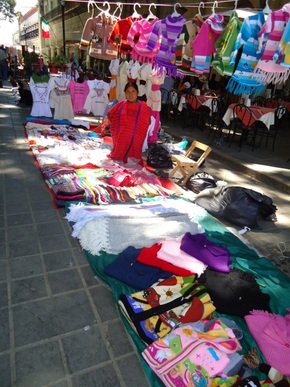
Street vendor in front of outdoor café on Oaxaca's zócalo.

Many visitors to the south central Mexico colonial city of Oaxaca spend only two or three full days here (aside from touring the central valley routes), not long enough to really learn about its
cultural history, its contemporary greatness, and a little about its underbelly.  There are indeed some detailed walking tours of the city contained in some guide books, but each of the three or four downtown routes requires a couple of hours to complete, if justice is to be done.  

One tour a day is often all that tourists have the stamina to do, given the sun, the elevation and jet lag. This, then, is a down-and-dirty single touring route for those who will be in the city for only a short period of time, and want a brief overview of what there is available.  It is suggested that
you do the tour your first full day, in the morning, and then return to the places which pique your interest later on in your visit. 

Upon your arrival, obtain a complimentary Oaxaca city map from your lodging.  All accommodations give them out for free. The centro histórico, or downtown historic center, is usually clearly demarcated, and all the streets noted in this tour route should be noted.  The walk takes a couple of hours.  It begins at the upper end of Calle Garcia Vigil, and concludes at Calle Morelos, near the Soledad church, towards the west end of downtown.  There, at the Jardín Socrates, you can relax and enjoy a fresh, cool nieve, or sherbet. If you’re not up to walking without a break for a full two hours, you can stop for a drink and snack mid-way, at one of the outdoor restaurants lining the main downtown square, or zócalo. Consider Terranova, east side of the zócalo, second outdoor restaurant from the bottom.

Beginning the tour, walk up Garcia Vigil until you see the old stone arches on the left.  This area is known as Los Arquitos.  This was a functioning aqueduct, built during the 18th century by the Spanish, delivering water to the city from a few miles further north, a suburb now known as San
Felipe del Agua.  Additional lengths of the aqueduct are as well found outside of the city and northern suburb.  The aqueduct originally continued further downtown, with arteries extending out from it in both directions, enabling residents to obtain water. Note that the stone used in its
construction is green limestone, used in most city construction during colonial times. It was also used to construct pre-Hispanic buildings.  It is still used today together with cement and reinforced steel to build retaining walls for both residential and commercial buildings, and as interior adorning accents.  You’ll no doubt come across the more common green stone, but perhaps also hues of pink and yellow during your visit to Oaxaca. 

Los Arquitos now houses the odd restaurant, business, and home; in some cases you can walk through the archways and onto cobblestone streets.  This is one of the quaintest neighborhoods in
Oaxaca!

Turn around and begin walking back south.  On your right, up a flight of exterior stairs you’ll encounter a state run craft store (ARIPO) with a smattering of artisans’ works from throughout the state.  Take a look through the store since it will give you an idea of what you’ll be coming across during your visit to the city and outlying craft villages.  Don’t hesitate to buy, notwithstanding that this will be your first day in Oaxaca, because the quality is good, and prices are not out of line. 
On the other hand, you might want to simply make a mental note of items you like, and the prices, and consider returning to the store just before concluding the Oaxaca segment of your vacation. 

Continue along Garcia Vigil, up a bit and then begin the descent.  About a block down on your right you’ll see the Benito Juárez museum, a home where Benito Juárez, Mexico’s first indigenous president, lived for part of his life.  It contains period furniture, original documents and photos, and an explanation about Juarez´s importance, accomplishments, etc. Personally, I think there are much better museums in the city, but some history buffs might be interested in coming back and touring it. 

Across the street and a bit further down is the Carmen Alto church.  It was founded on the site of an Aztec temple which was dedicated to the corn deity.  What better way to attempt to stamp out indigenous religions, than for the Spanish to build a Catholic church right on top of a native temple. 
This kind of thing was repeated time and again throughout Mexico, and in Oaxaca in particular (i.e. building the church at Mitla on top of an indigenous temple, using stones hewn by hand by the natives to build their own religious and administrative buildings). The Carmen Alto (las carmelitas descalsas) church restricted attendance to whites into the second half of the 20th century; those with overt signs of indigenous blood were restricted to praying in Carmen Bajo. 

Turn left at the bottom of Carmen Alto, down a paved, wide pathway with shops on the right. 
It’s only a one-block walkway.  On the right, halfway down is a small variety store, or so it seems.  There are two rooms filled with contemporary and vintage masks for sale, but if the owner isn’t there you cannot get into that part of the shop.

You’ve passed by several bohemian-looking street vendors, and are now at the city’s main pedestrian walkway, Macedonio Alcalá, where you turn right.  On your left is part of the ethnobotanical gardens, with high walls.  Walking down, on your right is the Institute of Graphic Arts, donated to the city by renowned Oaxacan artist Francisco Toledo.  It houses a library and store where you can purchase items made in the hand-made paper factory located outside of the city at San Agustín Etla, also noted for its spectacular fine arts center housed in a restored 19th century textile mill. 

On your left is the complex housing the Santa Domingo church and cultural center.  Take a peek into the church, and remember it for a return visit. It’s the most elaborate church in this part of Mexico, with amazing gold, biblical stories painted on the domed ceiling, etc.  The cultural center / museum is one of the finest in all Mexico, and if justice is to be done takes a couple of hours to wander through. The ex-convent itself is quite amazing. On the other (back) side of the church and cultural
center is the entrance to the enthnobotanical gardens (on Calle Reforma).  In revolutionary times it served as a cavalry barracks.  If you decide to do the ethnobotanical tour it must be done with an on-site guide.  Check, but English guided tours are generally on Tuesdays, Thursdays and
Saturdays at 11 am, and during high tourist season should be booked in advance.

But stay on Alcalá, walking a block further down where you will turn left at the Jardín Labastida (your street map with show M. Bravo to the right, and Abasolo to the left; around the time of the
revolution many street names changed, but your map should have the current names; in addition, some street names change at Alcalá, and others at Independencia.)

Before turning onto Jardín Labastida, just down Alcalá on the right side you should note Amate Books, the most comprehensive English language bookstore in the city. Now continue along the
Jardín Labastida, along the middle walkway, and at the end you will find a reproduction of an early “toma agua” where locals would attend to “take water” from one of the arteries leading out from the aqueduct. The park used to be a place where young artists would sell their work, and often would get their start.  The municipality decided around 2012 that it would no longer allow artists to use the park, a pity to my thinking.  

Turn right at the far end of the park by the toma agua, and head down Calle 5 de Mayo.  The left side of the street is completely taken up by the exterior walls of the luxurious Quinta Real
hotel.  Over the centuries it had housed municipal offices, a jail and a convent.  You can freely walk through the hotel from 9 am to 7 pm, so use this as an opportunity to stroll through history, looking at the refurbished frescoes, the lavabos (wash basins) which were used by the nuns, etc. 

Continue heading down 5 de Mayo, and turn right at the first corner, onto Murguia. On your right you’ll see Arte de Oaxaca, one of the best and oldest art galleries in the city, usually with high
quality rotating exhibits.  There is a permanent exhibit dedicated to the late great master of Mexican art, Oaxacan Rodolfo Morales. His influence can be seen in the work of most contemporary local artists.

Turn left onto M. Alcalá.  On the south east corner you’ll find Taller de Orfebre, a good, quality
jewelry store. Keep walking down.  On your left you will come across the museum of contemporary art of Oaxaca (MACO), worth a visit at a later time.  On Calle Morelos, just west of Alcalá on the north side you’ll see Monte de Piedad, the oldest pawn shop in the city, with something for everyone, but only at times, so you likely will not want to check it out, noteworthy as it is. 

Still on Alcalá, south of Morelos on the right side is the law school, virtually across the street from, sorry, Burger King. On the left side, a bit up, is an old bookstore, Grañen Porrua.  Walk through to the back and you’ll see a wall with a work of art by craftsman José Luis Garcia, a well-known artist
from nearby Ocotlán de Morelos, known for its Friday marketplace. 

Keep walking down Alcalá.  The name changes at Independencia, and traffic on the street begins. But keep walking straight down and you’ll hit Oaxaca’s famed central square, its zócalo. 

The zócalo has been important throughout history as a meeting place, for prominent locals to be seen and to mingle, and more significantly for protesters to air their grievances. Oaxaca’s zócalo is synonymous with civil unrest and disobedience, but it is virtually always a safe place to be, to have a meal or drinks and snacks and to people watch. Every night there is action on the zócalo, with mariachis, marimbas, and throughout the week on specific days the state band and dancing events such as for danzón. A good website which outlines both permanent weekly and short-run
activities is http://www.oaxacacalendar.com.  On the south side of the zócalo, where there are usually protesters, is the municipal palace, now housing art exhibits.  It is also home of a famous mural depicting the history of Mexico.  

Before walking up the other (west) side of the zócalo, note that there are two must-visit markets southwest of the zócalo, down a block and over to the west, the Benito Juárez and 20 de Noviembre
markets.  Do not miss them, if only for walk throughs.  They are marked on your maps.  Now walking up that west side of the zócalo you will pass by additional outdoor cafés and upstairs
restaurants. 

Just beyond the zócalo proper is another square, the Alameda de León, with the Cathedral on the right, and a landmark old hotel on the left, Hotel Monte Albán with some of the oldest original ironwork on the exterior that you will see in the city. Just up from it is the post office, and
on the other side of the street in front of you, Independencia, is the Museo de los Pintores Oaxaqueños, usually worth a look see, perhaps on a gallery hopping day.  Before leaving the Alameda, walk through the Cathedral and notice that the pulpit is in the middle rather than at the end, and the unusual seating arrangement. 

Turn left on Independencia.  On the right side of the street, at the corner of Tinoco y Palacios, is
the San Felipe Neri church, where Benito Juárez wed. The inside has the best example of Baroque architecture that you will likely find in the state, certainly during your visit to the city. Across from the church is the Carmen Bajo church, a low building.  During a major earthquake over a hundred years ago, it was destroyed and then rebuilt. By contrast, San Felipe Neri was not significantly damaged, so the original structure remains.  The bedrock on the north side of the street is different from that on the south side, and hence one church stood while the other fell. 
 
Continue walking west along Independencia until you come across an outside staircase on your right, just before the Soledad temple. Walk up the stairs, visit the church (known for the story of the
Virgin of the Soledad), and then sit down at one of the outdoor stands at Jardín Socrates for a cool, refreshing nieve, sherbet made with either water or milk.  The range of flavors is remarkable. On the north east end of the square is the school of fine arts.  While Oaxaca does not have a particularly good reputation for education, fine arts and linguistics are exceptions.

Above Jardín Socrates and to the west of the fine arts school is a large open area with seating, Plaza de la Danza where there are frequently artistic performances.

Your tour is coming to an end, so walk back to your hotel, presumably to the east, along Morelos, the street above Independencia at the top of Plaza de la Danza.  A couple of blocks over, as you are
walking back, on the north side of Morelos you will see the Rufino Tamayo Museum of Pre-Hispanic Art.  Make a mental note of it, and the days and hours of operation, since it is a really nice, well
arranged museum with exquisite figures in it, easily seen in a half hour or so.  Even for those who are generally not museum-goers, this one should pique your interest.

Enjoy Oaxaca!

Alvin Starkman first visited Oaxaca in the late 1960s, as a teenager.  He was a He frequently walked the city streets between 1991 and 2004, when he took up permanent residency.  He now
occasionally takes visitors to learn about the central valley sights such as craft villages, natural wonders, etc, specializing in the culture of Oaxaca’s premium spirit, mezcal, as well as the pre-Hispanic drink pulque.  He can be reached at
[email protected]. His wife operates Casa Machaya Oaxaca Bed & Breakfast (http://www.casamachaya.com). 


Oaxaca Mezcal Chocolate Pairing Evening Exposes Complex Issues

4/12/2014

 
Picture


Chefs Arcelia Gallardo & Pilar Cabrera, at the Restaurante La Olla chocolate / mezcal pairing evening, in March, 2014

She’s a tease. There’s no doubt about it. “No, not yet, you have to wait until I’m done first, please,” she entreats.  While the foreplay is interesting, and sensuous to the extreme, I want to jump right in – and get at the three young mezcals, with 18 chocolates set up in front of them.  

The evening was billed a mezcal and chocolate pairing event, or a maridaje in local parlance, held at Restaurante La Olla in downtown Oaxaca.  It was hosted by owners Chef Pilar Cabrera and Ing. Luis Espinoza, and their special guest, chef/chocolatier Arcelia Gallardo.[1]  Mezcal brands Koch and Vago were featured.

Of course Chef Gallardo simply wanted us to hold off delving into her enticing chocolates alluringly set in front of us, with water at the ready and three mezcals in the wait. The idea was to direct us
when to sample what, in the course of her discourse. 

This was more than a mezcal and chocolate combining encounter.  It was a treatise on the history of cacao, a lesson on the production of chocolate, and a discussion of its different formulations based on country / continent of origin.  In addition, of course, there was the main focus, learning an appreciation of different mezcals as paired with a variety of chocolates.  Each chocolate had been hand-crafted that very day by Chef Gallardo using Oaxacan ingredients she had earlier sourced with the assistance of Chef Pilar.

“I came to Oaxaca principally to learn about the region’s unique flavors and ingredients, with a view to experimenting with how I could incorporate what I discovered into my chocolate,” she explained. 

Yes, the packed house learned about chocolate’s Mesoamerican origins, the differences between South American, African and American cacao concoctions, what exactly white chocolate is, why
chocolate melts in your mouth (and in fact in your hands), and tasting notes relative to each sample devoured.  But for me, a mezcal aficionado and researcher for in excess of two decades, what struck home most were the elements in common between and contrasted with cacao and chocolate on the one hand, and the iconic Mexican spirit on the other. 

Naturally I was interested in everything Chef Gallardo had to say, given that it was all new to me; and who doesn’t have an interest in the wherefores and whys of chocolate?  But I continually found myself relating what I was being coached about cacao and chocolate, to mezcal as well as pulque. 

The Historical Record

In tracing the use of cacao to the Olmec civilization some 3,000 years ago, our grand maestra noted that residue of the cacao compound theobromine has been found in pottery vessels, evidencing its
earliest consumption in Belize and Guatemala.  My interest initially piqued recalling that archaeologists in Mexico have found clay pots with traces of alcohol, leading them to theorize about a pre-Hispanic distillation tradition.  Many Mexican spirits thinkers take issue with this latter reasoning, primarily because there have not been codices, pictographs and the like found, detailing distillation as a cultural indicia among indigenous groups. The more accepted thinking is that the Spanish learned distillation from the Moors, and subsequently brought this knowledge to The New World, no earlier than in the first quarter of the 16th century. 
 
With her powerpoint presentation Chef Gallardo showed us photographs of various paintings and clay containers, representing a Mayan god embracing a bowl containing cacao; a squirrel holding a pod; cacao vessels in ancient tombs; Aztec glyphs and notations in scriptures; a goddess of
cacao; and more.  The proponents of pre-Hispanic distillation, by contrast, have not been able to tie together the slight evidence of alcohol, with neither drawings nor stone or clay representations of anything beyond fermentation.[2] Where to date they have failed, the chocolate historians have convincingly succeeded.  

Modern Day Manifestations of Commonalities and Contrasts

One of the main positives in common between the production of chocolate and mezcal relates to the concept of bio-diversity and agro-forestry.  Chef Gallardo pointed to cacao plantations being suited to multiple crop land use.  Cacao can be shaded by allspice and coconut, and cardamom is capable of providing good ground cover.  Regarding mezcal production, in between rows of agave and at times growing simply amongst the plants, crops such as alfalfa, garbanzo, corn, beans and squash are frequently found, enabling growers to reap annual rewards while waiting for their principal crop to mature – often eight to ten years after planting, at times much longer.[3]

Chef Gallardo lamented the backbreaking work of cacao growers, and the often paltry wages they are paid, at least relative to the retail prices designer chocolate fetches. Farmers are required
to check the trees as often as on a daily basis to ensure infestations do not take hold.  Agave, on the other hand, requires very little attention.  But the work of those who spend their days in the sun-drenched fields and slopes cutting the plants out of the ground and lifting the resultant piñas onto
trucks, is grueling enough.  
 
While the current price per kilo of agave used in mezcal production is upwards of tenfold and in some cases more, compared to what it was only three or four years ago, this fact does not necessarily translate to farmers obtaining an appropriate piece of the pie, given the work they do and market fluctuations.  The same holds true for artisanal distillers. The lion’s share of
campesinos and palenqueros[4] are not enjoying an appreciably better standard of living, as compared to what is happening outside the villages of production.  The price of export quality mezcal will continue to rise.  As compared with the vagaries of living for the growers and producers, there will be no peaks and valleys in the financial fortunes of its foreign agents, its importers, and its retailers be they stores, bars or restaurants. In this vein, concerns by some “in the know” regarding the mezcal industry mirror those with a social conscience in the chocolate industry, such as Chef Gallardo. 

Chef Gallardo commented briefly on the use of fertilizer for growing cacao, stating that many growers do not even know the term, let alone about the issue of chemical versus organic growth
stimulants.  My mind raced along to those mezcal producers boasting organic production, and recalling a friend in pulque production telling me that he composts whatever animal feces is available
to use as fertilizer for his pulquero agave,[5] but that it really isn’t enough to provide a significant change in growth pattern, and that in any event he simply cannot afford chemical fertilizers. Most small scale agave growers are practicing organic production without even considering the marketing aspect of their practice.[6]

But what struck home perhaps the most were other matters relating to regulation and marketing of chocolate production, issues which mirror concerns of some commentators in the mezcal industry.  And even if those concerns are not at the fore in chocolate chats, then they are certainly on the minds of chocolatiers such as Chef Gallardo. 

Two sheets of paper in front of each attendee contained square boxes, with a different chocolate in each, with producer and origin noted:  Dandelion from Venezuela and the Dominican Republic; Madécasse and Akesson from Madagascar; and Valrhona from Africa.  As the lecture proceeded, we began tasting the chocolates while discerning different appearances, aromas, textures and finally tastes.  In the course of an extremely enlightening question and answer session, Chef Gallardo confirmed what I assume most of us had at least considered, that origin is a major determinant of
flavor.  I asked from what country(ies) the African chocolate we have sampled is derived. 
She replied: 

“There are so many trade secrets in the industry. There is no labeling requirement to disclose country of origin or even the percentage of powder versus cacao butter used in production.”[7] 
 

The chocolate from the Dominican Republic has dried cherry tones.  “The country taste is clear,” Chef Gallardo confirms, then continued, “our Madécasse Madagascar sample contains vanilla.”[8]

If producers label chocolate from Madagascar with the country of origin, why do they not label chocolate from other countries in Africa in a similar way, given in particular the extreme
diversity in climatic regions and terroir on the continent and the importance of country of origin in determining flavor?

I am less than a novice when it comes to cacao and chocolate.  However, no doubt there are ongoing round table discussions and perhaps even cogent and convincing answers to the foregoing question and other matters relating to labeling. 

As the evening progressed I proceeded to consider comparisons and contrasts and live issues in the mezcal industry which relate to chocolate regulation.[9]

Labeling of mezcal for export is regulated to a significant extent, although quality, quantity and parameters are often debated.  We have denominación de origen, alcohol content and percentage agave used in production all required to be noted. I have personally questioned whether the mezcal industry would be better served with more comprehensive labeling of region where the agave was grown versus fermented versus distilled, and species and subspecies of agave given the plethora of
often confusing local variations in terminology.  But after having heard what’s going on and arguably lacking in chocolate regulation / labeling, I began to think perhaps our own back yard is not doing all that bad.[10]

The Pairings

The first mezcal Koch we sampled was a madrecuixe.[11]  Chef Gallardo paired it with a truffle filled with seasonal guava.  We then scoffed another truffle with the same mezcal, filled with panela.[12] Our final pairing with Koch madrecuixe was a hard chocolate made with pecan and dried cranberry.

The second Koch mezcal was infused with gusano.  For me and for most of the crowd it provided the best-suited mezcal for combining, no doubt due to Chef Gallardo’s expertise.  I usually do not drink
mezcal de gusano. However I found that the semi-hard chocolate topped with a chapulín both complemented and moderated what is often too strong a gusano flavor.  The second chocolate entry
was made with chiles guajillo and chilhuacle amarillo, the tangy chocolate subtly and correctly overpowering the larva-laden mezcal. The final Koch pairing was with a hard chocolate made with local corn and coconut. 
 
The Vago mezcal was made with corn grown in the same micro-climate where the mezcal was produced, near the tiny Oaxaca hamlet of Candelaria Yegolé. The corn had been infused in a quantity of mezcal espadín,[13] then distilled in a copper alambique  topped up with additional espadín a la mezcal de pechuga. The first chocolate was a truffle spiked with rosita de cacao,[14] one of the requisite ingredients used to make tejate, the local, high-nutrition corn and cacao pre-Hispanic drink.  The second was an overly salty yet nevertheless complementary milk chocolate made with chipotle and topped with sea salt.  The final chocolate entry combined with the Vago mezcal was prepared with pinole.[15]

Mezcal Pairings: Chocolate is But One in the Realm of Combining Partners  

Mezcal viewed as a sipping spirit is still in its infancy.  And even more so is the perception of it as a beverage worthy of giving consideration for pairing. Some twenty years down the road, perhaps sooner, we might find on our bookshelves a compendium of different types of mezcal best suited for combining with different beverages, desserts and other foodstuffs as well as full meal offerings.  Indeed some producers of mezcal añejo have already begun to market by recommending particular qualities of chocolate best combined with their spirit.  

Evening sessions have begun to pop up pairing a selection of beers from a particular craft brewery with mezcals from a specific distillery. I envision more professionals’ efforts working to find the
perfect mix of mezcals with both popular sweets and main courses, especially in those regions of Mexico where mezcal is a locally produced spirit, and in major international centers where the spirit is now in vogue.  

Be more conscious of which mezcal you’re drinking with what, continue to combine with different chocolates, and like me, consider what’s behind the production and marketing of each.  In this way you’ll support the development of healthier industries, for our benefit and for everyone, in particular those who currently remain near and at the bottom of the production chain.   
  
  
[1] Chef Gallardo was named “Most Gifted Chocolatier” by the San Francisco International Chocolate Salon in 2013, and Silicon Valley Latino Magazine named her one of the “40 under 40 Latinos to Watch.”
  
[2] Pre-Hispanic fermentation has been well documented, in particular with respect to harvesting aguamiel and its conversion into and consumption as pulque. 
  
[3] Depending on the species of agave, the climatic conditions and terroir and the ultimate use (i.e. in the case of Agave salmiana grown for pulque production, in the central valleys of the state of Oaxaca maturity is usually reached only after between about 12 and 20 years).
  
[4] As small scale producers are known in the state of Oaxaca.
  
[5] In his case, Agave salmiana.
  
[6] Certification as organic raises the price of agave and consequently mezcal. Most small scale agave growers are practicing organic production without even considering the marketing aspect of their practice. The use of chemical additives during the process of fermenting baked/steamed agave and agave juice is another issue, beyond the scope of this essay and otherwise best left unaddressed.
  
[7] The more cacao butter, the faster it melts, an important consideration for some chocoholics.
  
[8] Frequently added in the chocolate making process.

 [9] I asume that whether it’s mezcal, chocolate or any other food or drink industry, similar issues are being debated on an ongoing basis. 
 
[10] Ah, but except of course when it comes to access by small uncertified producers to the export marketplace. 
  
[11] Agave karwinskii.
  
[12] More commonly known across Mexico as piloncillo.
  
[13] Agave angustifolia Haw.
  
[14] This is not actually the flower of the cacao, but rather of a native flowering bush, Quararibea funebris, the flower having a pleasing maple-like aroma.
  
[15] A toasted corn ground to a powder and sweetened with piloncillo, often flavored with ground cinnamon and other ingredients.

Alvin Starkman operates Mezcal Educational Excursions of Oaxaca.  A resident of Oaxaca for the past decade, he has written over 280 articles about life and cultural traditions in the central valleys of the state. 
 

    Archives

    October 2014
    September 2014
    August 2014
    July 2014
    April 2014
    December 2013
    November 2013
    October 2013
    August 2013
    July 2013
    May 2013
    April 2013
    March 2013
    February 2013
    January 2013
    December 2012
    November 2012
    October 2012
    September 2012
    August 2012
    July 2012
    June 2012
    May 2012
    April 2012
    March 2012
    February 2012
    December 2011
    November 2011
    October 2011
    September 2011
    August 2011
    July 2011
    June 2011

    Alvin Starkman

    blogs as a contributing writer for Mexico Today, a program for Marca País - Imagen de México

    Categories

    All
    Alebrijes And Copal In Oaxaca
    Barro Negro
    Beer Food Pairing Mexico
    Chango Mezcalero Mezcal Oaxaca
    Chango Revisited
    Chapulines Oaxaca
    Charities In Mexico Oaxaca
    Charity For Women In Oaxaca
    Chocolate & Mezcal
    Church Attire In Mexico
    Cooking Classes In Oaxaca
    Craft Beer Oaxaca
    Cultural Event Oaxaca
    Day Of The Dead
    Day Of The Dead 2013
    Dining In Oaxaca
    Doña Rosa
    Driving Oaxaca Mexico
    Economy Of Oaxaca Mexico
    Ecotourism Mexico
    Education In Oaxaca
    Feria Del Mezcal
    Frida Kahlo Diego Rivera Dolls Mexico Oaxaca
    Fundación Harp Helú Health Project
    Gift Giving Oaxaca
    Guelaguetza In Oaxaca
    Healthcare In Mexico
    Hongos In Oaxaca
    Imss For Expats
    Inapam
    Ixtle Agave & Sustainability
    Magic Of Mushrooms In Mexico
    Mexican Art
    Mexican Beer
    Mexican Drug Wars
    Mexico Food
    Mexico Globalization And Infrastructure
    Mezcalaria Book Review
    Mezcal Clay Pot Ollas
    Mezcal De Pechuga
    Mezcalerias In Oaxaca
    Mezcal Export
    Mezcal Exporting
    Mezcal Fair Oaxaca
    Mezcal In Mexico (Oaxaca)
    Mezcal In Michoacán
    Mezcal In South African
    Mezcal Nuances Complexity
    Mezcal Society Oaxaca
    Mezcal Sustainability
    Mezcal & Sustainability
    Mezcal Sustainability Revisited
    Mezcal Tour Oaxaca
    Mezcal Vago
    Mezcal Women Oaxaca
    Micro-financing In Mexico
    Miniatures Artist Mexico
    Morelia En Boca Michoacán
    Mushroom Hunt Cuahimoloyas
    Mushrooms Hongos Oaxaca
    Mycology In Oaxaca
    Oaxaca Isthmus Of Tehuantepec
    Oaxaca Tours
    Organic Produce Oaxaca
    Pairing Beer & Mezcal
    Pechuga Mezcal
    Photography Oaxaca
    Promexico And Mezcal
    Rabbit Hunting Mexico
    Safe To Travel To Mexico
    Shopping In Mexico
    Sustainable Industry In Mexico
    Tejate In Oaxaca
    Temazcal Oaxaca
    Tlacolula Nieve Mezcal Fair
    Walking Tour Oaxaca

    RSS Feed