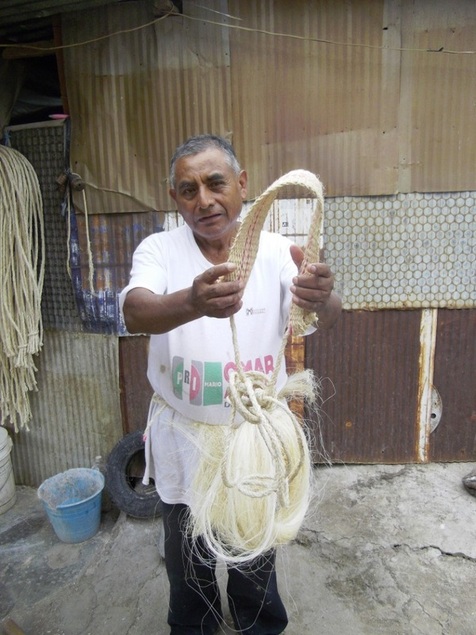
Valentín Rodriguez stands 10 yards away from Juana, who is peddling a large, thick wooden wheel with long strands of fine fiber attached. Don Valentín is nimbly twisting the threadlike filaments, known as ixtle, almost magically transforming them into rope, known as mecate. Remember when twine was made of light colored fibers such as hemp, linen, cotton and sisal, before the Western marketplace became flooded with brilliantly colored polypropylene and nylon cord of varying calibers sold in hardware stores from large rolling spools? For the time being, at least in Oaxaca, it still is.
Producing rope from the broad, spiny leaves of a particular class of agave plant is one of the oldest surviving manufacturing industries in Mexico, dating back well over 2,000 years. And in the southern state of Oaxaca it today represents yet another dimension of sustainability relating to the production of mezcal and pulque.
The 70-year old Zapotec craftsman is making rope out of the pencas of pulquero agave, as he’s been doing for the past 55 years. The only difference is that now Don Valentín buys the fiber in 150 or 200 kilogram bales. When he first learned his trade he fashioned the fiber out of fresh, green agave leaves, using an extremely labor intensive process. Some folks in his hometown village of Santa Domingo Xagacía still do it the old fashioned way, from scratch.
Valentín Rodgriguez and Family; From Santa Domingo Xagacía to Colonia Yasip, Tlacolula
In 1984, Don Valentín moved from Xagacía to his current homestead in Colonia Yasip, a neighborhood in the foothills above Tlacolula de Matamoros, about a 40 minute drive from the state capital, Oaxaca de Juárez. Tlacolula is best known to both visitors to Oaxaca and residents of the state for its vibrant Sunday marketplace.
Don Valentín lives with his wife, five children and grandchildren. A sixth, Simón, lives directly across the street, with his own family. Simón and his wife also make mecate. Altogether there are a half dozen families in the colonia and surroundings making mecate and other ixtle by-products. They sell them mainly to stores and in regular weekly and livestock marketplaces in cities such as Oaxaca, Zaachila and of course Tlacolula.
“”We used to make a lot more products other than just rope; mecate is now used mainly for tying farm animals and sometimes as clotheslines and the odd other assorted use,” laments Don Valentín. He still produces the mecapal, a long piece of twine affixed to a woven forehead band, employed by campesinos to carry mainly firewood on their backs; from the forests, through the fields, along dirt roads and pathways, and finally to their homes. But the days of producing clothing, footwear, floor mats, netting known as ayates utilized primarily for harvesting crops and holding and carrying infants, and even hammocks, are fast disappearing.
Early Production of Ixtle and Its By-Products in Santa Domingo Xagacía
Don Valentín’s father taught him how to make mecate, and several other types of utilitarian products once needed for day-to-day living in Oaxaca; all from the fiber of the agave leaf. His father learned from his father; and so the tradition was passed down from generation to generation, beginning in the region once a sedentary lifestyle had been established by early Zapotec inhabitants.
Don Valentín recalls:
“Until I moved to Tlacolula we made mecate the way it’s still made today in my village. I learned every stage of the process from my father; but of course sometimes others taught me when the two of us couldn’t do everything by ourselves. We would bake about 20 leaves from the pulquero agave, piled on top of one another in a narrow pit, flipping them once after they turned yellow, making sure not to burn any too badly to render them useless for turning into mecate. Once we had a big pile of them we would pulverize them using a large, heavy wooden mallet, exposing the fiber. We then put big heavy rocks on top of them to squeeze out any remaining juice. We would bring down fresh water from the spring or stream, and leave the mashed fiber in the water for a couple of weeks until it began to rot. Later we mashed it again and left it for a further 15 – 20 days. Finally we would use a metal scraper to get off all the remaining flesh, then leave the completely fibrous material in the sun to dry for one or two days, depending on the time of year.”
Agave, Sustainability & Loss of Tradition
Sustainable industries in Oaxaca have been documented elsewhere as relating to the production of both mezcal and pulque. In the case of mecate and mecapales currently produced in Tlacolula by Don Valentín and others, there’s been a dramatic change since these rural villagers began to develop a more urban lifestyle facilitated through emigrating from Santa Domingo Xagacía.
“In the olden days, after making mecate and other products with my father back home, we would fasten it all onto our backs and walk a whole day to get to Tlacolula for the Sunday market,” Don Valentín explains. He continues:
“But after I moved, I learned about a tractor trailer that had begun to come to Oaxaca from Yucatán, filled with ready-made ixtle for sale. So I started buying bales rather than making it myself. The ixtle I used to make from local pulquero agaves was and still is much better than the industrialized Yucatán stuff we now use, but this way it’s much easier and quicker. Now, every two or three months I simply have a light transport truck pick up the ixtle from the trailer in Oaxaca.”
Don Valentín says that the industry is changing even more dramatically, with less Xagacía villagers producing mecate: “I think there are fewer than 800 people in Xagacía now. The older generation is dying off, and youth are leaving, either coming to Oaxaca, going to other states altogether, and of course many head to the US.”
There isn’t the demand as there was before, perhaps because of the lesser quality of the mecate made from imported fiber, inexpensive imported synthetic product, or the inability of men like Don Valentín to compete with rope of varying thicknesses which can be cut to any length in a matter of seconds. Yes, he does do custom work, but orders are few and far between. And how much can he charge, when his price for a dozen, four-and-a-half foot lengths of one-third inch mecate is only 20 pesos, about $1.70 USD?
Ixtle & Mecate in Oaxaca a Generation Hence
If Don Valentín and his family are any indication, in less than a generation a sustainable Oaxaca industry may have vanished. Five of six progeny do not maintain the tradition. Four are employed operating small, motorized three-wheeled taxis known as moto-taxis. The fifth, who is a chauffeur for a van company which transports residents between Oaxaca and the coast, is even more pessimistic: “I don’t think it’ll be around in even ten years, the way things are going.”
Don Valentín does now have a permanent Sunday stall at the Tlacolula market; but in addition to mecate and mecatales, he’s now making 100% synthetic carrying bags and selling them from his market stand. “That’s my bread and butter,” he bemoans.
Alvin Starkman is a contributing writer for Mexico Today, a program for Marca País – Imagen de México. Alvin has written over 270 articles about life and cultural traditions in Oaxaca and its central valleys. Alvin has a particular interest in mezcal, pulque and all agave derivatives. He enjoys sharing his passion for Oaxaca with tourists to the region.
 RSS Feed
