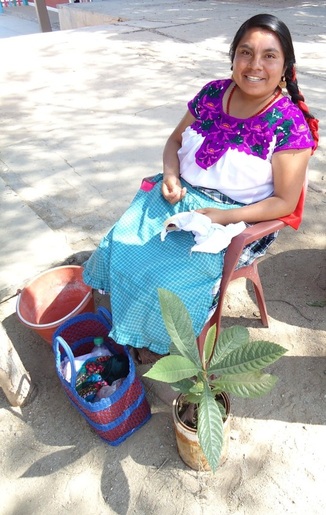
While there are indeed producers of certified organic foodstuffs and spirits in the central valleys of the southern Mexico state of Oaxaca, the question arises as to whether tourists on a short visit, or residents of its capital, Oaxaca de Juárez, should go out of their way to seek out production from these purveyors. Are there healthy, sustainable and environmentally friendly alternatives to shopping in the Friday and Saturday organic market in the Xochimilco neighborhood in the north end of the city, or patronizing restaurants which boast using certified organic produce or being Slow Food proponents?
Cultural, Historical Background to Organic, Free-Range Production in Oaxaca
More than 10,000 years ago nomadic hunters and gatherers first appeared on the Oaxacan landscape; in the central valleys, on the coast, in the mountainous regions of the Sierra Madre del Sur, on the arid desert plains, and elsewhere.
When sedentary lifestyles eventually emerged, cultivation of plants, fruits and vegetables began to take hold, alongside domestication of animals. Production of corn originated in this part of Mexico, and so along with beans and squash came some of the earliest vegetables and legumes under cultivation. The arrival of the Spanish in Oaxaca in 1521 resulted in the importation of new products, including animals such as sheep (which were not indigenous to the New World), as well as additional nuts, fruits, herbs and vegetables.
But the state of Oaxaca remained effectively isolated from the rest of the country, and self-sufficient. Geographical seclusion to a large extent continued until the Pan American highway reached Oaxaca in the late 1940s. And even since then, many parts of the state have remained rugged and removed from mainstream Oaxacan society. The eight broad geographical areas in the state, characterized by extremely diverse climatic and growing regions, have continued to support large native populations.
The implication of the foregoing is that many local populations within the state’s 16 indigenous cultures have remained, into the 21st century, almost entirely self-sufficient and reliant upon centuries old production methods, without resorting to chemical insecticides or fertilizers; in effect, models for organic, green and sustainable production.
Organic Non-Certified Agricultural Production in Oaxaca Today
Organically produced fruits and vegetables, as well as free range chickens, turkeys, goats and other hoofed edible animals are readily available for purchase by consumers, and for consumption in restaurants – without there being any visible seal or signage suggesting the means by which growth has been attained. There need not be a label on produce in local markets indicating “certified organic” or a Slow Food logo on restaurant menus. And if a product is available for sale in an “organic market,” does that automatically mean that it has been grown without the use of chemical pesticides or fertilizers, simply by virtue of where it is being offered for sale?
Most small scale farmers, campesinos, cannot afford to use synthetic products to stimulate growth or inhibit infestation. Just as significantly, they have learned how to grow organically, having watched and assisted their grandparents, their great grandparents, and the generations before them.
It is not suggested that all local producers follow the pure and natural pathway to economic subsistence, but rather that many still exist, are accustomed to and comfortable with their production methods and continue to resist change – benefiting the middle class health conscious, foreigners and Mexican nationals alike.
It’s the certification, and the logo evidencing certain claims, which are at issue. Many restaurants in Oaxaca serve dishes using organically produced foodstuffs without indicating any designation whatsoever; and vendors at many markets don’t even go as far as suggesting means of production. It’s simply expected that buyers know that they’re purchasing fresh and organic.
The same rural vendors who have been producing fruits, vegetables, herbs and meat for generations, organically, green and sustainably, sell directly to some restaurants as well as to consumers, quietly and without fanfare – and without charging a premium to cover the cost of membership in a certification program.
There’s nothing wrong with supporting “organic markets” in Oaxaca, buying certified organic produce and meats, and patronizing restaurants boasting that they are proponents of the Slow Food movement. But you do pay a price. Furthermore, with a little homework (i.e. asking and visiting rural producers) you can eat just as green and sustainable food and just as pure mezcal, without demanding to see a label evidencing proof. It’s easy to support the little producers whose life is organic and free range, and always has been.
Ask in some of the better yet small and quaint downtown Oaxaca restaurants. Visit marketplaces in the city on their market days where you’ll see vendors sitting at the entranceways or outside, on the ground, selling produce they’ve picked perhaps 12 hours ago, just prior to hopping on a bus to Oaxaca. You can find the same thing by venturing out of the city to weekly village marketplaces, in addition to poultry, goats, and so on.
It’s much more difficult to buy green when in New York, Chicago, Toronto or Los Angeles. And so it makes sense in such cities to go where you have the assurance, based on reputation, labeling and marketing. But Oaxaca is different, and in fact distinct from other cities and regions in Mexico, especially from those in the northern half of the country. It’s easy to maintain an organic, sustainable lifestyle in Oaxaca, without paying the price and supporting commercial enterprise, and at the same time supporting small, rural organic producers.
Alvin Starkman operates Casa Machaya Oaxaca Bed & Breakfast with his wife Arlene (http://www.casamachaya.com), and Oaxaca Culinary Tours with Chef Pilar Cabrera (http://www.oaxacaculinarytours.com). However, the opinions expressed herein are Alvin’s alone. He has written over 280 articles about life and cultural traditions in Toronto, and frequently takes tourists to the state to visit the central valley sights.
 RSS Feed
