Alvin Starkman, M.A., J.D.
I have twice written about the history of the highly collectible vintage chango mezcalero. The clay vessel in the shape of a monkey and commonly used to hold and market Mexico’s iconic spirit, mezcal, has long intrigued both folk art collectors and ardent aficionados of the distillate. Why a monkey? Where and when was the art form first produced? I opined that a meeting with a founding father of the Aztompa pottery tradition would further elucidate, and perhaps even lay the matter to rest.
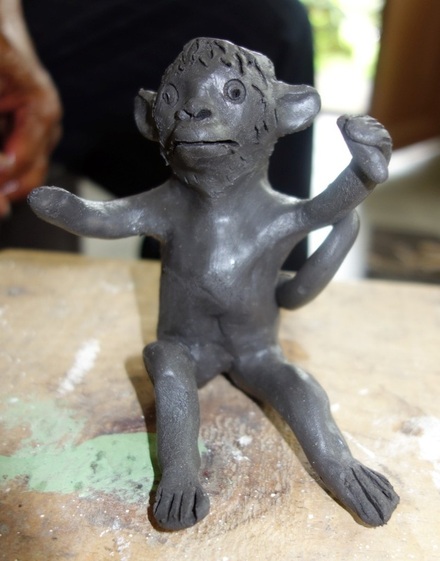
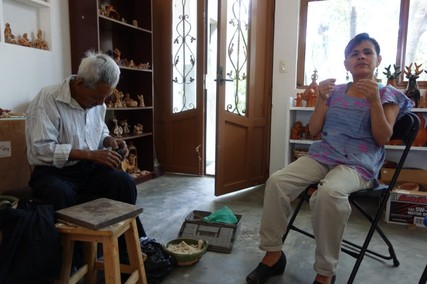
Ernesto Vásquez Reyes, the 90 year old father of acclaimed clay sculptor Angélica Vásquez Cruz, sits on a black vinyl covered ottoman at his daughter’s workshop in Santa María Atzompa. At Angélica’s request, on this particular afternoon in June, 2014, Don Ernesto is sculpting a clay mezcal monkey bottle, the infamous chango
mezcalero. They want to illustrate how he used to make the receptacles, one of the earliest forms of Oaxacan folk art. But somewhat surprisingly, it is revealed that the flasks that Don Ernesto used to fashion were not for holding mezcal, at least initially.
Atzompa is about a 20 minute drive from Oaxaca, the colonial city in south central Mexico. For decades Atzompa has been known for its green glazed pottery, though a few sculptors such as Angélica have stepped out of the mold and achieved international praise for their production of purely decorative, museum quality folk art. Oaxaca and its encircling central valleys are noted for pre-Hispanic ruins, colonial architecture including exquisite Dominican churches, the best cuisine in all Mexico, craft villages including those which produce clay products, and, the agave-based spirit
mezcal.
The thinking has been that monos or changos, that is monkeys, have long been associated with drunkenness, and thus the non-human primate form was an appropriate way to capture the interest of those who would gift something apropos to the habitual agave-based spirit imbiber. I had uncovered competing claims to the invention of the bottle, by two families in San Bartolo Coyotepec.
Since the 1950s San Bartolo Coyotepec has been renowned for black pottery. Before then and dating to pre-Hispanic time, most villagers had made their living producing and selling or trading grey functional pottery. These pieces had been fired for 12 hours or more, thereby enabling them to hold liquids. The innovation of barro negro by the famed San Bartolo Coyotepec potter Doña Rosa Real Mateo, had led to the proliferation of an industry based on the production of non-utilitarian shiny black pottery – barro negro. It does not hold water because it has been fired in a wood burning kiln under low heat for only 8 – 9 hours.
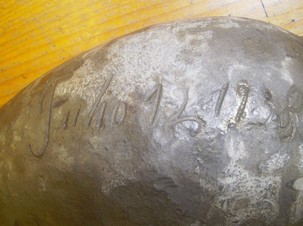
The discovery of a clay chango mezcalero mold dated July 12, 1938, packed away in one of the dusty old boxes of memorabilia of Doña Rosa’s husband Juventino Nieto Real, and discussion with his heirs, appeared to conclude the inquiry. A reasoned assumption was that chango mezcalero was first innovated in San Bartolo Coyotepec by Juventino Nieto Real in 1938.
 However, questions persisted. What about the contemporary chango industry in the self-proclaimed World Capital of Mezcal, Santiago Matatlán, one of the earliest colonial settlements? Furthermore, the Águilar Alcántara sisters, well-known potters of Ocotlán de Morelos, advance that their mother Isaura Alvántara had made clay monkey bottles in the 1940s, and possibly earlier. And finally, Don Ernesto’s daughter Angélica indicated to me before this more recent encounter, that her father had been making chango mezcaleros since the first half of the last century. In fact a few months earlier he had made some for me. |  |
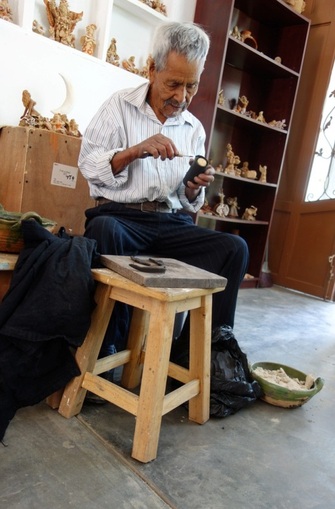 | 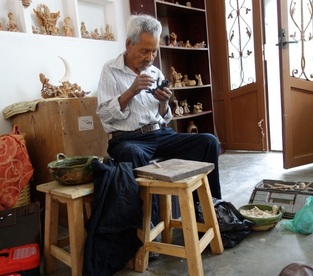 |
Don Ernesto begins by pounding out enough Play-Doh pliable clay to make the chango. He sends one of his grandsons out back to fetch a 1½” diameter, 5” length of tree limb. He fashions the clay
completely around the branch. “This is the only kind of mold I have ever used,” he quietly yet firmly
asserts, as he carefully removes the limb from the clay, yielding a perfect cylinder. “I would usually make these little men quite a bit larger, to hold a liter, perhaps less.” Don Ernesto then confides that he still has the same bottle “mold” at home that he always used to make his larger changos.
The form had been acquired by his grandfather during or about 1835.
Little men? Maestro Ernesto proceeds to relate a couple of legends about monkeys, how they were at one time men who were mysteriously transformed into monkeys, then boulders at the base of a monolith; and how they would seemingly at will change from human to simian:
“That’s why I call them little men, and that’s why we started making them out of clay, a sort of homage to the stories passed down; no, to me chango mezcaleros as you call them, the ones I used to make, had no relationship to drunkenness, and in fact in our village we did not make them to hold mezcal, just water.”
With hands still nimble despite advancing years, he forms the legs, arms, tail and head, asking for a sharp object to make facial features. “Can someone get me a cactus needle,” he implores.
Don Ernesto concedes in matter-of-fact fashion that the real chango mezcalero, the clay monkey shaped and sometimes painted bottle which was used for mezcal, came from San Bartolo Coyotepec:
“The clay from our area would not hold mezcal; water yes. Water easily seals our type of clay once baked, so the water in the receptacle doesn’t seep or evaporate. But not so if we fill a bottle with
mezcal; after a while it would begin to disappear.”
As a young boy in the 1930s, Don Ernesto began making clay figures in the form of monkeys and other creatures which were of significance in his life, though perhaps not as important as the “little
men.” Then towards the end of the decade, curiously around the time Don Juventino began making his chango mezcaleros from that now famous mold, Don Ernesto began making clay bottles in
the form of monkeys. But they were used strictly for water. It was not until a decade or two later that glazes began to be used in the village, so distilled liquids such as mezcal could be held without seepage or evaporation.
Since the use of glazes post-dated Don Juventino’s 1938 monkey mold, we can confidently conclude that Atzompa was not the cradle of chango mezcalero. However, it certainly does not take a great leap of faith to see how the more modern changos Don Ernesto produced for me would pique the fancy of collectors of both Mexican folk art and mezcal paraphernalia. The chango has the form, now capacity to hold the spirit, and the ability to capture the imagination of those who would display it in a place of prominence in a home, bar or mezcaleria. It speaks a story.
Research continues with a view to more comprehensively filling in the history of chango mezcalero in Oaxaca. The complete tale of the clay monkey bottle has yet to be definitively told.
Alvin Starkman has been an aficionado of Mexican distilled and fermented beverages for over two decades. He runs Mezcal Educational Excursions of Oaxaca. Alvin is the author of Mezcal in the Global Spirits Market: Unrivalled Complexity, Innumerable Nuances, and co-author of the only full color comprehensive bilingual mezcal tasting wheel.
 RSS Feed
