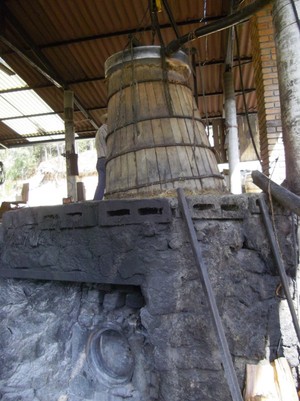
Typical Mezcal Still in Michoacán Decidedly Different from Oaxacan Alambique. In Oaxaca a two chamber copper apparatus is used; here a single unit does the job of distillation just as efficiently, imparting different flavor nuances. Read more and learn how the family of Don Emilio has been producing mezcal at the family vinata for five generations.
Don Emilio is moderating a mezcal cata (tasting) at the May, 2012, annual gastronomy and wine festival, Morelia en Boca. “In Oaxaca they drink their mezcal with sal de gusano, but in Michoacán we use our locally produced cheese, queso cotija,as a chaser and side condiment,” he explains. “The difference is just a matter of varying traditions between the two states.”
The state of Michoacán in central Mexico, of which Morelia is capital, is home to approximately 700 mezcal producers, a significant number, though admittedly pale compared to the literally thousands in Oaxaca, the largest producer and exporter in the country. But Michoacán nevertheless has a long and varied history of mezcal production, probably dating back as far as its Oaxacan counterpart, to the 1500s.
Emilio Vieyra Vargas and his father own and operate Mezcal Don Mateo de la Sierra. Don Mateo was Emilio’s great grandfather. He migrated from Guanajuato to Michoacán in 1840, and began producing mezcal. Given that Don Emilio represents his family’s fifth generation of maestro vinatero (in Oaxaca referred to as palenquero), what better ambassador of the spirit of Michoacán.
“In Michoacán we use five varieties of agave to produce mezcal, while in Oaxaca they use 12 – 15, or perhaps more,” Don Emilio continues. But the differences between mezcal in Oaxaca and Michoacán run much deeper than nomenclature and varietals of agave. Certainly type of agave (also referred to as maguey throughout Mexico) and growing region factor into flavor characteristics, but variation in the means of production is also a key ingredient in determining distinctions in nose, tones and ultimate overall taste.
The Mezcal Don Mateo vinata (factory, or palenque in Oaxaca parlance) is located just outside of the village of San Miguel del Monte, nestled high up in the pine and oak forests, a 40 minute drive from Morelia. On the final approach to the vinata one witnesses the tapping of trees, with sap dripping into tin cans, so slowly that it’s undetectable. It’s visually akin to trekking through maple orchards in central Ontario in early spring and seeing syrup pails hanging from spigots. “The sap has a number of uses, but they’re unrelated to mezcal,” Don Emilio clarifies. “It’s just that these trees and the agave we use are equally suited to this elevation and other climatic conditions.”
Although 80% of the mezcal Don Emilio produces is made with wild agave, the family does cultivate its own maguey on the rolling hills below the vinata. “We make our mezcal utilizing four of the five varieties used in the state,” he indicates. “Most of our sales are from cupreata, perhaps because it produces a mezcal a bit sweeter than the rest, and second most popular is americana; we also do a blend of the two.” The other two types of agave used in the Don Mateo vinata are ineaquiden and angustifolia. Some producers also use agave azul, of tequila fame.
The baking of the agave in an in-ground, airtight oven over rocks and firewood is the only significant commonality between traditional production of mezcal in Oaxaca, and in Michoacán. And even then, at least in the case of the vinata of Mezcal Don Mateo, the firewood used is exclusively (green) oak, as compared to in Oaxaca where a number of different species of tree are utilized.
Some Oaxacan mezcal operations have moved away from firewood, to a fossil fuel engine which pumps vapor into a sealed room. It flows through tubing on top of which there is a grate piled high with agave, thus effectively steaming the maguey. “None of us in Michoacán use vapor, but over in San Luis Potosí some do it that way,” Don Emilio distinguishes.
“Here in Michoacán we have never used a horse or donkey dragging a big limestone wheel over the baked agave to crush it, like they do in Oaxaca,” he continues. “We used to pulverize the plant using a big wooden mallet, but now many of us use an electrically powered chopping machine to cut the maguey into tiny pieces in preparation for fermentation.”
While in Oaxaca custom dictates fermenting in 2,000 liter pine tubs, Don Emilio uses 5,000 liter rectangular tanks cut into the ground, lined with oak boards. In keeping with family custom, only spring water is used to top up the tanks holding the baked mashed maguey.
The Michoacán alambique (still) bears little resemblance to its Oaxacan counterpart. The latter is comprised of a brick or stone encased oversized copper pot with conical lid. It connects to copper tubing rising above and across it, attaching to a copper serpentine submerged in a companion tank of water. The Michoacán still, by contrast, is a single unit. The only copper component is the large pot enclosed in a stone and mortar housing. An oak cylinder extends above it. A funnel – shaped stainless steel cone filled with water sits on top of the cylinder and extends back down into it.
In the Oaxacan palenque, firewood (again often different types) heats the crushed agave fiber and fermented liquid, steam rises through the copper apparatus, and when it descends through the copper serpentine in the tank of water, it condenses. In the Don Mateo vinata mainly oak is used to fuel the still. The steam rises through the oak cylinder, condensing when it touches the stainless steel water-filled cone.
Esteban is the Mezcal Don Mateo manager of sales. He accurately summarizes the factors which give his mezcal its flavor nuances, distinguishing it from the spirit produced by other maestro vinateros and Oaxaca’s palenqueros:
· The variety of agave (Oaxaca continues to use mainly espadín)
· The climatic region including elevation and soil composition
· The means of cooking such as using vapor and in what kind of room or drum (i.e. clay brick, stainless steel, etc.), as distinguished from over (what type of) firewood
· The characteristics of the fermentation containers
· The distillation equipment employed
Superimposed on each of the foregoing are more subtle deviations and distinctions (beyond the purview of this essay) , as well as the variables of time and number; length of time the agave grows and for how long it remains in the fields after its quiote (stalk) is cut before harvesting, number of days of warm versus cold weather and centimeters of precipitation (over the course of several years of growth), length of time the agave is baked and at what temperature, number of days the crushed baked maguey is allowed to ferment as often determined by ambient temperature, and the controls placed on distillation time and speed.
For tasting, Don Emilio has on hand mezcal made from agaves cupreata and americana, and a blend of the two. He’s now aging in white oak barrels, but none is currently available. However there are variations of the foregoing three on this morning in his vinata, based on vintage of the harvest and length of time stored in glass containers, whether the particular varietal of agave is wild or cultivated, and pechuga. All told about ten mezcals are sampled, out of the 20 he produces throughout the year.
Pechuga generally connotes chicken or turkey breast. During the second (and usually final) distillation, breast meat is hung in the still in a cloth bag (similar to and serving the function of cheesecloth), often with other local foodstuffs including seasonal fruit. Don Emilio’s wife’s recipe calls for chicken breast, deer meat and a blend of select spices. The mezcal takes on a fuller, richer taste.
Don Emilio quite accurately ballparks the percentage alcohol of his mezcal based on the size of the perlas (literally pearls, or bubbles) it produces when poured, and how long it takes for them to dissipate. Of course he does have alcohol meters for more precise measurement for commercial bottling and labeling, but soundly boasts; “after so many years of being a vinatero I can pretty well tell you the strength.” Most of his mezcal is in the range of 48 – 52 % alcohol by volume.
The same mezcal with two different alcohol contents takes on different flavor characteristics including sweetness. More alcohol does not necessarily mean less smooth. Alcohol content is marked on each of the filled multi gallon glass containers in his small warehouse, along with month and year of distillation and distinguishing features of the agave, ready for bottling for the retail buying public, in smart 750 ml bottles.
Mezcal from Michoacán cannot be exported from Mexico at the present time. Most producers are not registered with the federal government’s Hacienda, or tax department. But this is not the major impediment, given that the same holds true in Oaxaca. Rather, Michoacán mezcal must first be designated with a denominación de origen, which effectively provides consumers with a guarantee of origin and overall quality. Only then will COMERCAM (El Consejo Mexicano Regulador de la Calidad del Mezcal A.C.), the federal mezcal regulatory agency, begin to accepts registrations for the spirit’s export. Proceedings are under way.
In the interim, the best way to sample and buy Mezcal Don Mateo de la Sierra and other regional mezcals, is to visit central Mexico. That way you can make your way up to the vinatas, speak to the maestro vinateros, and most importantly learn first-hand about the mezcal of Michoacán.
Alvin Starkman has written over 250 articles about life and cultural traditions in Mexico, most often about Oaxaca. He has a particular interest in mezcal and pulque, and periodically takes visitors to Oaxaca to visit small mezcal palenques in the mountains, and into the fields to harvest aguamiel from which pulque is derived. He and his wife Arlene operate Casa Machaya Oaxaca Bed & Breakfast. Alvin is a paid contributing writer for Mexico Today, a program for Marca País – Imagen de México.
 RSS Feed
